

Failure to depart after voluntary departure: the penalties
An immigration judge gave you a date to leave, and that date is getting close. Maybe the passport has not arrived, or the money for the ticket is not there yet. You want to know what failure to depart after voluntary departure really costs.
The short answer has three parts. If you miss the deadline, your voluntary departure turns into a removal order. The statute also provides for a civil fine and ten years without access to several immigration benefits for anyone who voluntarily fails to leave within the period. The fine is presumed to be $3,000 when the order does not name another figure.
All three run from one date: the one written in your order.
How long you have to leave, and who decides
Voluntary departure is permission to leave the United States on your own, at your own expense. It takes the place of a removal order. It comes from section 240B of the Immigration and Nationality Act (INA). Our guide on how voluntary departure works covers who qualifies.
The immigration judge sets the deadline, and the statute caps it. You can get up to 120 days if the judge grants it before your case ends, and up to 60 days if the judge grants it at the end.
When voluntary departure is granted at the end of the case, the judge must explain the conditions first. You can accept them or turn voluntary departure down, under the immigration court regulation.
You cannot appeal the length of the period. If you are still weighing the choice itself, read our comparison of voluntary departure versus a removal order.
What failure to depart after voluntary departure costs you
There are three separate consequences, and they stack. The statute requires the order itself to tell you about the fine and the ten-year bar. Start by rereading it.
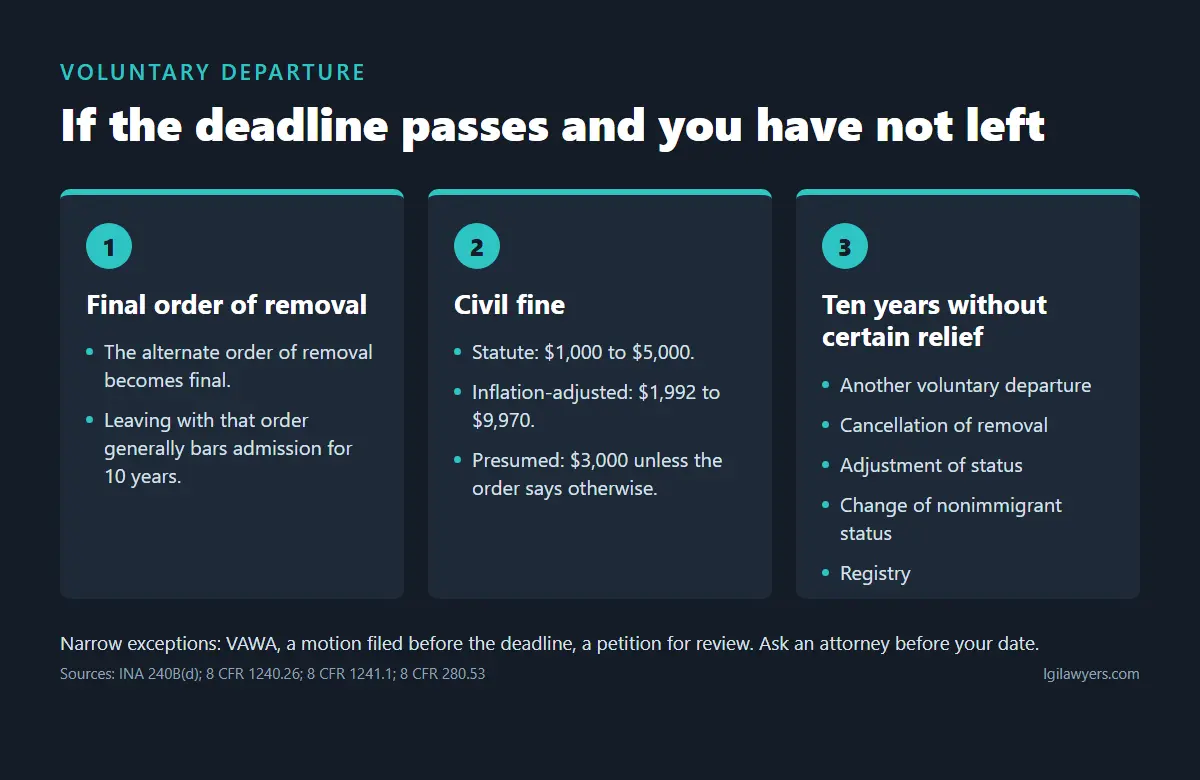
The alternate order of removal
Every grant of voluntary departure comes with a second order attached, called an alternate order of removal. It sits in the background while your departure period runs.
If you do not leave on time, the alternate order becomes a final order of removal, under the regulation that defines when an order is final. Permission to leave has become a removal order.
That order also affects your return. As a general rule, a person who leaves while a removal order is outstanding cannot be admitted for ten years, under INA section 212(a)(9)(A). Other time periods apply in some situations, as explained in our guide to returning to the US after voluntary departure.
If your deadline has already passed, read what a final order of deportation means.
The civil fine
You will see three different numbers for this fine, and all three are right.
- What the statute says. The INA sets the fine at $1,000 to $5,000.
- What applies today. The government adjusts civil fines for inflation. Under the current adjustment, the range is $1,992 to $9,970, according to the DHS table of adjusted penalties.
- What your order says. The regulation presumes a fine of $3,000, unless whoever grants voluntary departure sets a different amount within the allowed range.
That decision-maker is the judge or the Board of Immigration Appeals (BIA), the body that reviews immigration judges’ decisions. It must tell you the amount at that point.
The adjusted amounts are revised every year, so today’s range may not be next year’s.
Who actually issues the fine? An interim final rule of June 27, 2025 created a separate process run by the Department of Homeland Security (DHS). An officer issues a written decision. You have 15 business days from service of that decision to appeal in writing, and a DHS supervisor decides the appeal, under the regulation governing that process.
That process is being challenged in court. On September 30, 2026, a federal court in Massachusetts stayed the interim rule “and all fines issued thereunder” until further order of the court, in Maria L. v. Mullin, No. 25-13471-GAO.
On October 14, 2026, DHS and the Department of Justice published the final rule (91 FR 65390), effective the same day. It adopts the interim rule with one change: ICE will accept a late appeal as timely if it arrived late because of a documented mail delay beyond your control. The court order came before the final rule and does not address it. How these fines are issued and collected may change, so ask an attorney where things stand.
Federal law also has a separate daily fine for a person subject to a final removal order who willfully fails to leave, fails to apply in good faith for the travel documents needed to leave, or acts to prevent their own departure. This article does not cover whether that fine applies to you; ask an attorney.
If a fine decision arrives, write down the day you received it and get advice before the 15 business days run out.
Ten years without access to certain relief
This is the penalty with the longest reach. The statute makes a person who was granted voluntary departure and voluntarily fails to leave within the period ineligible for ten years for the following:
- Another grant of voluntary departure (INA section 240B).
- Cancellation of removal (section 240A), which lets certain people ask a judge to stop their deportation.
- Adjustment of status (section 245), the process for getting a green card without leaving the country.
- A change of nonimmigrant status (section 248), which lets a person admitted as a nonimmigrant who is still maintaining that status move to another nonimmigrant category.
- Registry (section 249), which allows a green card for a person who entered the United States before January 1, 1972 and has resided here continuously since then, among other requirements.
That is the list set out in INA section 240B(d)(1)(B). Before you let the date pass, ask an attorney how this bar would affect your case.
When the penalties do not apply
Three situations take the fine and the ten-year bar off the table. None is an easy way out, and two trade the penalties for a removal order.
The exception for abuse survivors is narrow. The ten-year bar does not block cancellation of removal or adjustment of status based on protections under the Violence Against Women Act (VAWA). It applies only if the abuse or extreme cruelty was a central reason you did not leave on time.
A motion filed before the deadline. If you file a motion to reopen or reconsider while your departure period is still running, voluntary departure ends automatically. The fine and the bar do not apply, but the alternate order of removal takes effect right away. The motion does not pause or extend your deadline either.
A petition for review in federal court. Filing one before you leave has the same effect: voluntary departure ends and the alternate order kicks in. The penalties do not apply while the petition is pending and you remain in the country.
Timing controls all of this. A motion filed after the deadline does not erase the penalties, even if the judge grants it. Discuss these routes with an attorney before your date.
What happens to the voluntary departure bond
The bond is money you put up as a guarantee that you will leave. It is required when voluntary departure is granted at the end of the case. Earlier, the judge may or may not ask for one.
The regulation sets the basics:
- Amount: the judge picks the figure, and it can never be less than $500.
- Deadline: you have 5 business days from the judge’s order to post it.
- Where: with the local office of Immigration and Customs Enforcement (ICE).
Not posting the bond does not cancel your duty to leave, and it does not shield you from the penalties. If you waived your right to appeal, missing the bond makes the alternate order of removal take effect immediately. The regulation leaves one opening: a person is not treated as having departed under a removal order if they leave within 25 days of the failure to post the bond, give DHS the proof of departure the ICE office requires, and show DHS they remain outside the United States.
Leave on time and you can ask ICE to cancel the bond by showing proof of your departure. Keep the bond receipt with your order.
What to do if you cannot leave on time
Can you go back to court and ask for a few more days? No.
The judge cannot extend the period the judge set. The regulation gives that power to certain immigration enforcement officials, not to the judge or the BIA. Even then, the original period plus any extension can never exceed the 120 or 60 days in the statute. If you received 60 days at the end of your case, there is no legal room for more.
Flights fall through and consulates run late, and that is not a failing on your part. Act as soon as you see the problem:
- Find your order and confirm the exact date and the fine amount stated in it.
- Gather what you have about the obstacle: consular appointments, bookings, medical records.
- Speak with an immigration attorney while your period is still open.
Every case is different, and options that exist before the deadline can be gone the day after.
CBP Home and voluntary departure before a judge
The two get mixed up because both involve leaving on your own. The voluntary departure in this article is granted by a judge, with a deadline, a bond and penalties.
CBP Home is a DHS program. According to its official page, it lets people without legal status in the United States and without a criminal record use a mobile app to report their intent to leave the country, with incentives and travel assistance.
The page also says that program participants have their civil fines for failure to depart after a final removal order or a voluntary departure order forgiven. And it recommends speaking with an immigration attorney before reporting an intent to depart. If you already have a voluntary departure order, do that before you use the app.
How to prove you left on time
Leaving is half of it. You also need to be able to prove it, because that proof is what gets your bond canceled.
The regulation has no fixed list of documents. It says proof is submitted by whatever methods the ICE office prescribes. Ask that office, or your attorney, what it accepts before you travel.
To be safe, keep everything that shows the date you left the country, such as your ticket or boarding passes. The ICE office decides what counts as proof. Leave copies with someone you trust in the United States.
Do you know how much time you have left to act?
In immigration matters, deadlines are strict and rarely extended, and missing one can permanently remove options that were available to you. Building a strong case also takes time: gathering evidence, preparing documents, and reviewing your history. That means the real window to act is always shorter than the deadline itself.
Frequently asked questions
How much is the fine if I do not leave on time?
The statute sets it at $1,000 to $5,000. With the current inflation adjustment, the range is $1,992 to $9,970. If your order does not state another amount, the regulation presumes $3,000.
Can I get more time to leave?
Not from the judge. The regulation reserves extensions for certain immigration enforcement officials, and the total can never exceed the 120 or 60 days in the statute. If you already received the maximum, there is nothing left to extend. Filing a motion does not add time either.
What happens if I leave one day late?
Filing a motion does not extend the period, and no extension can go beyond the 120 or 60 days in the statute. Once the period runs out and you have not left, the alternate order of removal becomes a final order. The statute also provides for the fine and the ten-year bar for anyone who “voluntarily fails to depart” within the period. If something is stopping you from traveling, talk to an attorney before the date.
Do I get my bond back?
You can ask to have it canceled if you left within your period and can prove it. The request goes to the ICE office, with whatever proof of departure that office requires.
Can I apply for a green card later if I missed the deadline?
For ten years, the law bars you from adjustment of status, which is the way to get a green card without leaving the country. A narrow exception exists for certain abuse survivors. Options from abroad follow different rules, which our guide on returning covers.
Your order’s date decides the rest
Nearly everything that can be done with voluntary departure has to be done before the period ends.
At Law Group International, attorneys Khalid Shekib and Daniela Lucena handle deportation defense for families in Virginia, Washington D.C., and Maryland. If you have a voluntary departure order, bring it to your consultation. The date is the first thing we will look at.
This article provides general information and is not legal advice. Reading it does not create an attorney-client relationship with Law Group International. Immigration law changes often and every case is different, so speak with an immigration attorney about your own situation.
Ready to prepare your case with an experienced immigration team?
Schedule a consultationKhalid Shekib & Daniela Lucena · Law Group International
Offices in Alexandria, VASources
- INA section 240B, 8 U.S.C. 1229c: voluntary departure, time limits, bond, fine and ten-year bar
- 8 CFR 1240.26: voluntary departure in immigration court
- 8 CFR 1241.1: when a removal order becomes final
- 8 CFR 280.53: inflation-adjusted civil penalty amounts
- 8 CFR 281.1: DHS process for issuing and appealing these fines
- INA section 274D, 8 U.S.C. 1324d: daily fine for failing to depart after a final order
- INA section 248, 8 U.S.C. 1258: change of nonimmigrant status
- INA section 249, 8 U.S.C. 1259: registry
- INA section 212(a)(9)(A), 8 U.S.C. 1182: inadmissibility after a removal order
- DHS and Department of Justice, interim final rule on civil penalties, 90 FR 27439, June 27, 2025
- DHS and Department of Justice, “Imposition and Collection of Civil Penalties for Certain Immigration-Related Violations,” final rule, 91 FR 65390, October 14, 2026
- U.S. District Court for the District of Massachusetts, Maria L. v. Mullin, No. 25-13471-GAO, stay order of September 30, 2026
- DHS, CBP Home
Last updated: October 2026.