


Administrative Warrants vs Judicial Warrants: Can ICE enter your home in 2026?
In February 2026, the Department of Homeland Security (DHS) made a significant and controversial announcement: immigration officers may enter the homes of individuals with final orders of removal using administrative warrants. This statement has sparked a nationwide legal debate about the limits of immigration enforcement and the protections guaranteed under the Fourth Amendment of the U.S. Constitution.
For many immigrant families, this raises urgent and deeply personal questions.
- Can ICE legally enter my home?
- Do I have to open the door?
- What kind of warrant do they need?
The answer depends on a critical legal distinction that is often misunderstood: the difference between an administrative warrant and a judicial warrant.
At Law Group International, we understand how quickly immigration policies can change, and how confusing those changes can be. This guide breaks down what administrative warrants are, how they differ from judicial warrants, what the Constitution says, and most importantly, what you should do if ICE comes to your door.
Understanding your rights is not just important, it can make a decisive difference in protecting yourself and your family.
What is an Administrative Warrant (I-205)?
Understanding the I-205 Administrative Warrant
An administrative warrant, commonly referred to as Form I-205 (Warrant of Removal/Deportation), is a document issued by immigration authorities, not by a judge. It is typically signed by an immigration officer and authorizes ICE to take a person into custody and carry out a removal order.
These warrants are used in civil immigration enforcement, not criminal proceedings. This distinction is important because civil enforcement operates under a different legal framework than criminal law.
ICE generally uses administrative warrants in cases where:
- A person already has a final order of removal
- The government is seeking to detain or deport that individual
- The case is being handled within the immigration system, not criminal court
In its February 2026 statement, DHS argued that administrative warrants provide sufficient legal authority for immigration officers to enter a person’s residence under certain circumstances. This interpretation relies in part on older legal precedent, including the Supreme Court case Abel v. United States (1960), which addressed administrative arrests in immigration contexts.
However, civil liberties organizations and many legal scholars strongly dispute this position. They argue that administrative warrants do not meet the constitutional requirements of the Fourth Amendment, which generally requires a warrant signed by a neutral judge to enter a private home.
As a result, this issue is likely to be the subject of ongoing litigation and evolving legal standards.
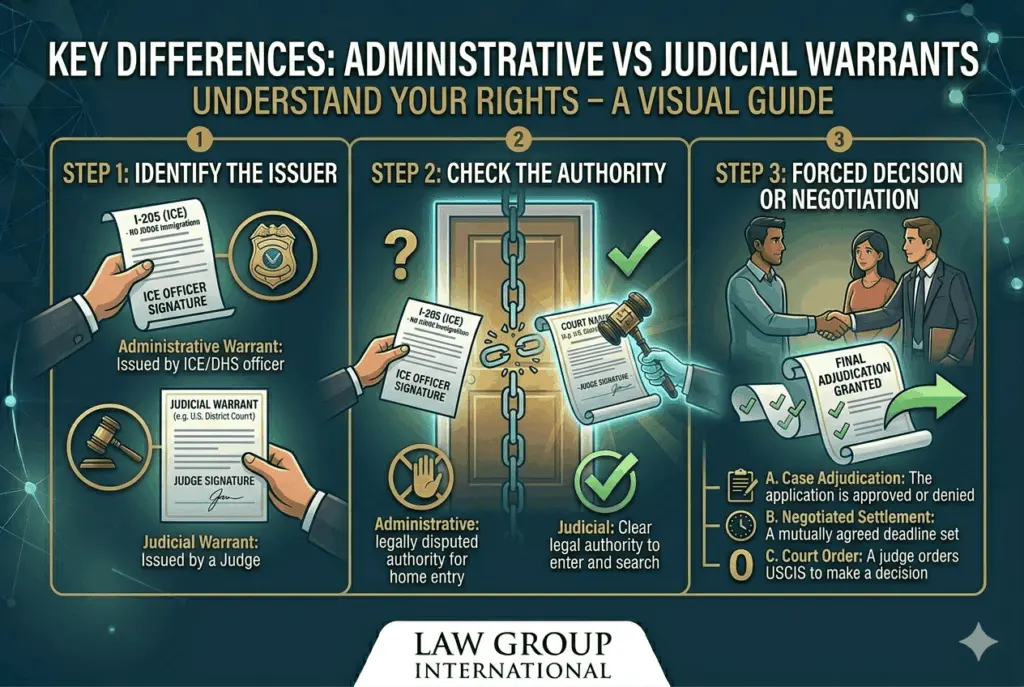
Administrative Warrant vs Judicial Warrant: Key Differences
Administrative Warrant vs Judicial Warrant: Key Differences
Understanding how to identify and distinguish these two types of warrants is critical.
| Feature | Administrative Warrant (I-205) | Judicial Warrant |
| Who issues it | ICE or DHS officer | Federal or state judge |
| Type of case | Civil (immigration) | Criminal or federal judicial matter |
| Authority to enter a home | Legally disputed | Clearly authorizes entry |
| Signature | Immigration officer | Judge |
| Constitutional basis | Administrative authority | Fourth Amendment protections |
| Common forms | I-200, I-205 | Search warrant, arrest warrant |
How to Identify Each
Administrative Warrant (I-205 or I-200):
- May say “Department of Homeland Security”
- Signed by an ICE officer, not a judge
- Often does NOT include a court name
Judicial Warrant:
- Clearly signed by a judge
- Includes a court name (e.g., U.S. District Court)
- Explicitly authorizes entry or search
This distinction matters because, in most situations, ICE cannot legally enter your home without a judicial warrant or your consent.
The Fourth Amendment and Immigration Enforcement
What the Constitution Says
The Fourth Amendment protects individuals against unreasonable searches and seizures. In general, this means that law enforcement must have a warrant signed by a judge to enter a private residence.
DHS’s position is that immigration enforcement operates under a civil framework that allows for broader administrative authority, especially when a final order of removal exists.
On the other hand, civil rights advocates, including organizations like the ACLU, argue that the Fourth Amendment applies equally to immigration enforcement when it comes to entering a home. According to this view, an administrative warrant alone is not enough.
Courts have not issued a single, definitive ruling that resolves this conflict nationwide. Instead, different jurisdictions may interpret these issues differently, and new legal challenges are expected in response to the February 2026 announcement.
Because of this legal uncertainty, it is especially important for individuals to understand their rights and exercise them carefully.
What to Do If ICE Shows an Administrative Warrant at Your Door
What to Do If ICE Shows an Administrative Warrant at Your Door
If ICE comes to your home, how you respond in that moment can have serious legal consequences. Here are key steps to follow:
- Do Not Open the Door
You are not required to open your door unless ICE presents a valid judicial warrant signed by a judge. - Ask to See the Warrant
You can ask officers to slide the warrant under the door or hold it up to a window. - Check the Type of Warrant
Look for:
- A judge’s signature (judicial warrant)
- Or an ICE officer’s signature (administrative warrant)
If it is an administrative warrant (I-205 or I-200), it generally does NOT authorize entry into your home.
- State Your Rights Clearly
You can say:
- “I do not consent to entry.”
- “Please leave.”
- Do Not Sign Anything Without Legal Advice
Documents presented by ICE may affect your legal rights. - Contact an Immigration Attorney Immediately
Legal guidance at this stage can be critical. An attorney can assess whether your rights were violated and what legal options are available.
For a broader overview, Law Group International recommends reviewing your rights during ICE encounters and having a plan in place before any interaction occurs.
Frequently Asked Questions
Is DHS correct that ICE can enter homes with administrative warrants?
This is currently a contested legal issue. DHS asserts that it can, but many legal experts and organizations disagree. Courts are likely to address this question in upcoming cases.
Can ICE force entry into my home?
Generally, ICE cannot force entry without a judicial warrant. However, specific circumstances may vary, especially if there is a final order of removal.
What if I have a final order of removal?
Even in this situation, you still have constitutional rights. ICE may attempt enforcement, but the type of warrant they present matters significantly.
Can an attorney challenge an unlawful entry?
Yes. If ICE enters your home without proper legal authority, an attorney may be able to challenge the arrest or evidence obtained as a result.
Protect Your Rights: Legal Guidance Matters
The question of whether ICE can enter a home with an administrative warrant is not just a legal debate, it is a real issue affecting families across the United States.
As policies evolve and legal challenges unfold, knowing your rights is your first line of defense.
At Law Group International, we help individuals and families navigate complex immigration enforcement situations, including arrests, detention, and deportation defense. Our attorneys, Khalid and Daniela, have experience analyzing whether ICE actions comply with the law and identifying possible defenses when rights are violated.
If ICE has come to your home or you are concerned about your risk, speaking with an immigration attorney can help you understand your options and protect your future.
Call Law Group International at (571) 503-7786 to schedule a confidential consultation.
You do not have to face these situations alone.