

Annual Asylum Fee in 2026: Consequences of Non-Payment and How to Protect Your Case
Last Updated: June 2026
If you have a pending asylum application in the United States, there is an important change that could directly affect your case.
Since May 29, 2026, USCIS has the authority to impose serious consequences on asylum applicants who fail to pay the new Annual Asylum Fee (AAF). For many applicants, non-payment no longer means a simple administrative delay. It can now result in the rejection of an asylum application, the loss of work authorization, and even the initiation of removal proceedings.
This policy affects hundreds of thousands of individuals with pending asylum cases across the country.
The Annual Asylum Fee was created through recent federal legislation and later implemented through an interim rule issued by the Department of Homeland Security (DHS). Although the original fee was set at $100, it was adjusted for inflation to $102 per application for Fiscal Year 2026.
Many asylum seekers are unaware that this requirement exists. Others have received notices from USCIS without fully understanding the consequences of ignoring them. In addition, some applicants have reported technical issues when attempting to make the payment.
In this guide, Law Group International explains:
- What the Annual Asylum Fee is and who must pay it.
- How to determine whether your payment is due.
- What happens if you do not pay within the required deadline.
- What options may be available if your case has already been rejected for non-payment.
If you currently have a pending asylum application, this is not an issue you can afford to ignore.
What Is the Annual Asylum Fee and Who Must Pay It?
The Annual Asylum Fee (AAF) is a mandatory payment that certain asylum applicants must make while their case remains pending.
For Fiscal Year 2026, the fee is $102, adjusted for inflation from the original $100 fee established by federal law.
Generally, the requirement applies to individuals who:
- Filed Form I-589, Application for Asylum and for Withholding of Removal.
- Have had their asylum application pending for more than one year.
- Have a pending case with USCIS or before the Immigration Court (EOIR).
It is important to understand that the fee is charged per application, not per person.
For example, if an entire family is included on a single asylum application, the required payment remains $102 for the application as a whole, not $102 for each family member.
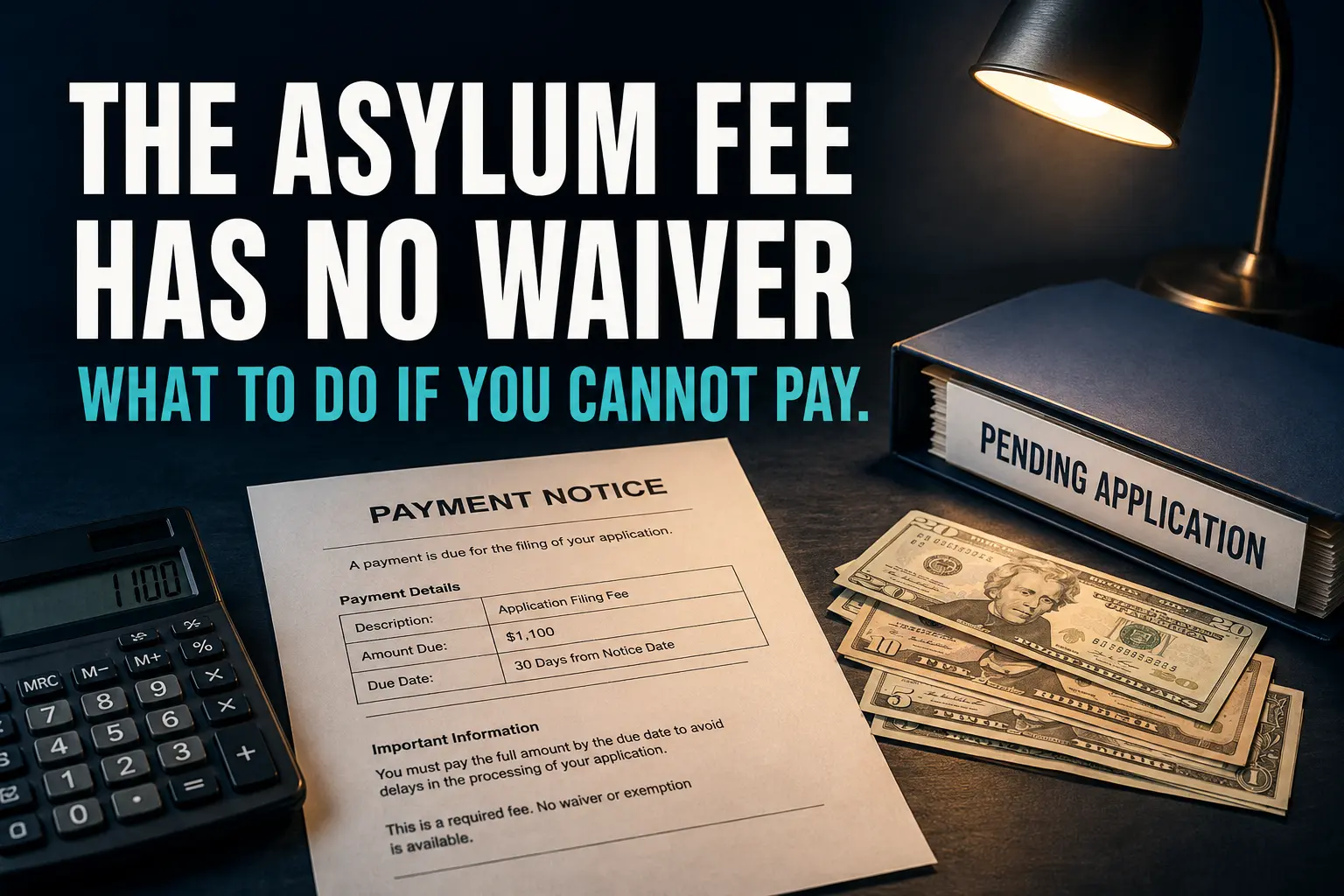
Another important distinction is that, unlike many immigration filing fees, the Annual Asylum Fee generally does not allow for fee waivers based on financial hardship.
USCIS has begun sending payment notices to eligible applicants and requires payment within the timeframe specified in the notice.
If you receive a notice related to this fee, it is critical to act quickly.
Consequences of Failing to Pay the Annual Asylum Fee
The consequences of non-payment are far more serious than many applicants realize.
Under the rule that took effect on May 29, 2026, USCIS may take several actions against applicants who fail to pay the fee within the required deadline.
1. USCIS May Reject Your Pending Asylum Application
The most immediate consequence is the rejection of the pending Form I-589.
This means USCIS will stop processing the case, and the application will no longer remain active.
2. USCIS May Deny Any Pending Work Permit Application
If you have a pending Form I-765 based on your asylum application, USCIS may deny your request for employment authorization.
3. You May Immediately Lose Your Current Work Authorization
The rule also provides that existing employment authorization based on a pending asylum application may become invalid if USCIS rejects the case for non-payment.
For many families, this is one of the most serious consequences because it directly affects the ability to work legally in the United States.
4. USCIS May Initiate Removal Proceedings
If you do not have another valid immigration status, USCIS may place you into removal proceedings.
What may seem like a relatively small administrative issue can quickly become a serious immigration problem.
How Long Do You Have to Pay?
Generally, applicants have 30 days from the date USCIS issues the notice, not from the date they open the letter.
For this reason, keeping your address updated with USCIS is more important than ever.
How to Verify Whether You Owe the Annual Asylum Fee
Many applicants do not know whether they are already required to make the payment.
Fortunately, USCIS has established a process for determining whether the fee is due.
Step 1: Access the USCIS Payment Portal
USCIS allows eligible applicants to verify and submit payment for the Annual Asylum Fee through its online payment system.
Step 2: Review Your Case Status
If the system displays a “Pay and Submit” button, it generally means the fee is due and payment can be made.
Step 3: Keep Proof of Your Status
If the system indicates that the fee is not yet due, take a screenshot and save it for your records.
Step 4: Check Regularly
Because of system updates and reports of technical issues experienced by some applicants, it is a good idea to check the portal regularly.
You should also monitor your mail and any USCIS online accounts associated with your case.
Do you know how much time you have left to act?
In immigration matters, deadlines are strict and rarely extended, and missing one can permanently remove options that were available to you. Building a strong case also takes time: gathering evidence, preparing documents, and reviewing your history. That means the real window to act is always shorter than the deadline itself.
Attorneys Khalid Shekib & Daniela Lucena · Alexandria, VA
My Asylum Case Was Rejected for Non-Payment. What Are My Options?
Receiving a rejection notice can be frightening.
However, a rejection does not always mean that all legal options have disappeared.
The first step is to speak with an experienced immigration attorney as soon as possible.
Depending on the circumstances, it may be necessary to evaluate:
- Potential options for refiling or correcting the issue.
- Whether administrative errors or technical payment problems occurred.
- Other forms of immigration protection that may be available.
- Possible defenses in removal proceedings.
- Eligibility for Withholding of Removal or protection under the Convention Against Torture (CAT).
Every case is different.
What works for one applicant may not be appropriate for another.
For that reason, Law Group International strongly recommends against attempting to resolve an asylum rejection without first obtaining legal advice.
Frequently Asked Questions
Are There Penalties for Not Paying the Annual Asylum Fee?
Yes. USCIS may reject your asylum application, deny pending work permit applications, revoke existing employment authorization, and in certain cases initiate removal proceedings.
Can I Request a Fee Waiver?
In most situations, no. The current rule does not provide a general fee waiver for the Annual Asylum Fee. Limited exceptions may exist for certain individuals covered by specific litigation or settlement agreements.
What If I Cannot Afford the $102 Fee?
Financial hardship does not automatically eliminate the payment requirement. If you are unable to pay, you should speak with an immigration attorney immediately to discuss possible options.
Does the Fee Affect Everyone on My Application?
The fee is charged per asylum application, not per person. If multiple family members are included on the same Form I-589, only one annual fee is generally required.
What If I Paid but USCIS Says I Didn’t?
Keep copies of payment receipts, screenshots, confirmation numbers, and any other proof of payment. If a processing error occurred, this documentation may be essential to correcting the problem.
What Is the Ms. L. Settlement Exception?
Certain individuals who are members of protected classes under federal litigation may be subject to different rules. If you believe you may fall into one of these categories, consult with an immigration attorney for an individualized assessment.
If You Have a Pending Asylum Case, the Time to Act Is Now
The new Annual Asylum Fee has significantly changed the landscape for asylum seekers across the United States.
What once may have seemed like a simple administrative requirement can now determine whether an asylum application remains active or results in rejection, loss of work authorization, and possible removal proceedings.
If you have a pending Form I-589, do not wait until a problem arises.
At Law Group International, attorneys Khalid Shekib and Daniela Lucena help asylum seekers throughout Virginia, Washington, D.C., and Maryland protect their cases, respond to USCIS notices, and evaluate legal strategies when issues involving the Annual Asylum Fee arise.
Ready to prepare your case with an experienced immigration team?
Schedule a consultationKhalid Shekib & Daniela Lucena · Law Group International
Alexandria, VA · Virginia, DC & MarylandExplore more immigration topics
Inside the Chantilly ICE Holding Facility
August 28, 2026

The Annual Asylum Fee Cannot Be Waived
August 23, 2026

Children Without Lawyers in Virginia Immigration Court
August 16, 2026

What Happens If You Miss Your Immigration Court Hearing
August 11, 2026
TPS Is Ending: Legal Options to Get Permanent Status
August 10, 2026

How to Protect Yourself from Immigration Fraud
July 20, 2026