


How to check your immigration court date with EOIR
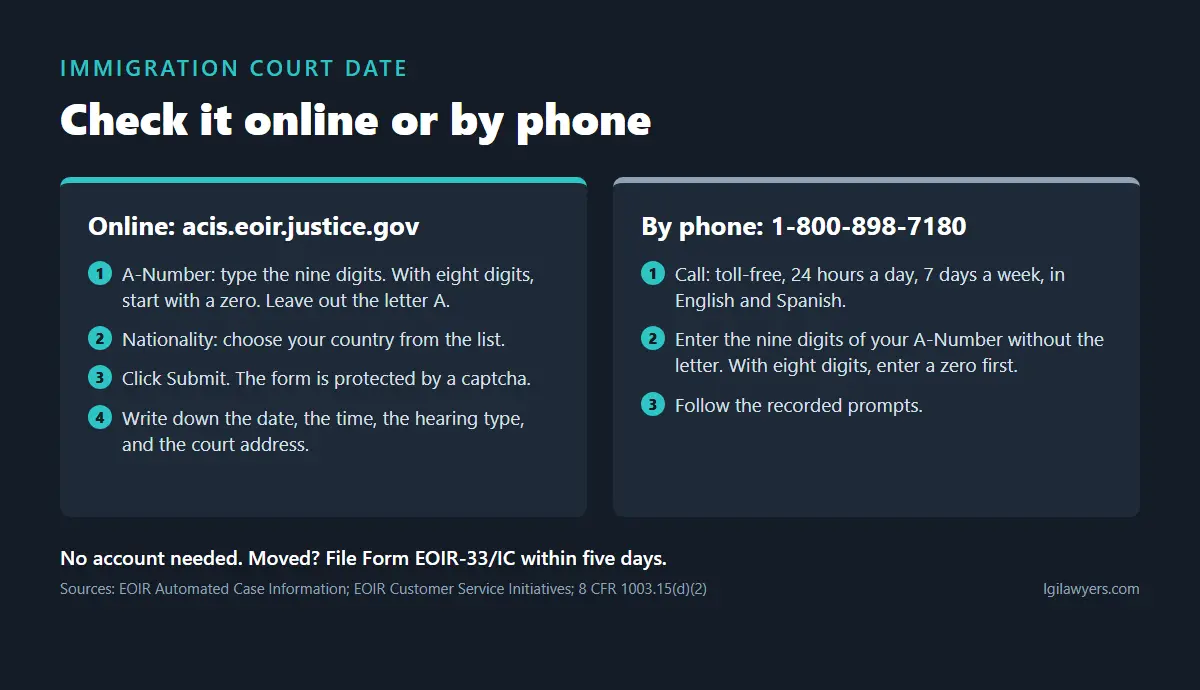
There are two free ways to check your immigration court date, and neither one requires an account. The first is the online Automated Case Information System run by EOIR, the Executive Office for Immigration Review. EOIR is the agency that operates the immigration courts. The second is EOIR’s automated phone line, 1-800-898-7180.
Online, you need two things: your A-Number and your nationality. For the phone line, EOIR mentions only the A-Number.
Keep in mind that the system is for convenience only. The only official record is the paperwork the court issues to you or your representative, and the page itself says so.
To see where each hearing fits in the larger process, our immigration court timeline lays it out.
What you need before you check your immigration court date
Your A-Number. This is your alien registration number: the letter A followed by eight or nine digits. EOIR says it is printed on all correspondence from the Department of Homeland Security (DHS) and from the immigration court. It also appears on your Notice to Appear (NTA), the document the government uses to start your case, because the regulation requires it.
If your number has eight digits, put a zero in front.
Your nationality. The system asks for the country that best describes your nationality during your most recent immigration case. Per its help text, that can be your place of birth, your country of nationality, or the last country where you habitually lived. If you have more than one nationality, the help text says to select one option and, if the first one is not on the list, to search for your second nationality.
How to check it online, step by step
These are the labels you will see on screen:
- Go to acis.eoir.justice.gov/en/. A language selector lets you switch between English and Español.
- Under “A-Number,” type the nine digits, one per box. With eight digits, start with a zero. Leave out the letter A.
- Under “Nationality,” open the list and choose your country. You can type the name to find it faster.
- Click “Submit.” The button only becomes active once both fields are filled in. The form is protected by a captcha, an automated check that a real person is searching.
- Read the result and write down the date, the time, the hearing type, and the court address.
Both fields are marked “Required,” and each has a help link next to it. The system does not ask for your name or your date of birth.
How to check it by phone
Would you rather call? EOIR’s automated phone system is at 1-800-898-7180. The call is toll-free, and the line runs 24 hours a day, 7 days a week, in English and Spanish. EOIR also lists 304-625-2050 and a TDD line for callers with hearing difficulties, 800-828-1120.
When the recording asks, enter the nine digits of your A-Number without the letter. If you have eight digits, enter a zero first. Then follow the recorded prompts.
According to EOIR, the line gives the date, time, and location of your next hearing. It also covers the judge’s decision and appeal information from the Board of Immigration Appeals (BIA). The BIA is the body that reviews immigration judges’ decisions.
What each result means
The online system sorts what it knows into four sections. Here are their titles:
| Section on screen | What it tells you |
|---|---|
| Next Hearing Information | The hearing type, the date, the time, and whether it is in person or internet-based. If nothing is scheduled, the text reads “There are no future hearings for this case.” |
| Court Decision and Motion Information | Whether the case is still pending or a decision exists, with its date, plus any motions on file |
| BIA Case Information | The deadline to appeal, whether the Board received an appeal, and the status of the briefs |
| Court Contact Information | The address and phone number of the court handling your case |
The hearing type shows up as one of two words. “Master” refers to a master calendar hearing, which, per EOIR’s Policy Manual, is held for pleadings, scheduling, and other similar matters. “Individual” refers to the evidentiary hearing on contested matters, such as applications for relief, also known as a merits hearing.
If your case is in Northern Virginia, see our Northern Virginia immigration court guide as well.
EOIR states several limits in writing:
- The system does not display all cases or all information about a case.
- It covers the primary case only. If your A-Number has more than one case, it shows the most recent.
- It does not include bond hearings. For those, you have to contact the court.
- It will not reflect a new hearing date until the court has set one.
So compare what you see on screen with the last notice you received in the mail.
If no case appears
The message reads: “No case found for this A-Number.” It is not a final answer. The system warns that a lack of information should not be the sole means of determining the status of a case.
Run through three checks before drawing any conclusion:
- Search again and review both entries. Check every digit, the leading zero if your number has eight, and the nationality you selected.
- Call 1-800-898-7180 and run the same search by phone.
- Contact the court listed on your Notice to Appear. EOIR keeps an immigration court directory that links to each court’s page, with its address and phone number.
EOIR does explain one scenario. If your Notice to Appear has no date and time, the court sends a follow-up Notice of Hearing, EOIR says. And according to the court’s change of address form, all official correspondence goes to the address you provided.
If you still cannot find your case after these steps, take your documents to an immigration attorney before assuming anything.
If you moved
Tell the court in writing, and do it fast. The form is EOIR-33/IC, the change of address and contact information form for the immigration court. You can get it from EOIR’s forms list, where it is also available in Spanish. A separate form, EOIR-33/BIA, is for cases pending before the Board of Immigration Appeals.
The deadline is worded two ways in official sources. The regulation, 8 CFR 1003.15(d)(2), says “within five days” of the change of address. The current form, revised in February 2026, and EOIR’s page on updating your information say “within five working days.” Work from the shorter deadline: file within five days of your move, counting every day.
The form’s own instructions cover how to file:
- Three options: online through EOIR’s Respondent Access site, in person, or by mail.
- A copy for the government: you must give a copy to ICE’s attorneys’ office, and the form includes the proof that you did.
- One per person: each family member with a pending case needs a separate form.
According to the form itself, the court only changes your contact information upon receipt of this form, and it will not change it based on different information in pleadings, motions, or other communications.
It matters because, under the statute, a hearing notice sent to the most recent address you provided is considered sufficient. Keep a copy of the form and your proof of filing.
If your date already passed and you did not go
This is serious, and it is understandable to feel alarmed. The law allows the judge to order removal in absentia, meaning without you in the room. To get that order, the government must prove that the written notice the law requires was provided and that you are removable.
That order is not always the end. The same statute lets you ask the judge to rescind it through a motion to reopen, a request to open the case again. The deadline is 180 days if you missed the hearing because of exceptional circumstances. There is no deadline if you did not receive the notice the law requires, or if you were in federal or state custody and could not appear through no fault of your own.
Every case is different, and here the reason for the absence drives almost everything. Speak with an immigration attorney right away, and read our guide to what happens if you miss a hearing.
Why it pays to check often
One search is not enough. The system shows the date the court has on its calendar at that moment. The official document is still the notice sent to you by mail. If the court sets a new date, you want to hear about it both ways.
It helps to make it a habit:
- Check regularly, even when your hearing seems far away.
- Check again a few days before the hearing.
- Open and keep every piece of mail from the court.
Do you know how much time you have left to act?
In immigration matters, deadlines are strict and rarely extended, and missing one can permanently remove options that were available to you. Building a strong case also takes time: gathering evidence, preparing documents, and reviewing your history. That means the real window to act is always shorter than the deadline itself.
Frequently asked questions
Where do I find my A-Number?
EOIR says it is printed on all correspondence you receive from DHS and from the immigration court. It also appears on your Notice to Appear, the document that starts your case.
Why does the system ask for my nationality?
Because it is a required field in the online system, just like the A-Number. If your search comes back empty, review that entry before concluding there is no case.
Can I check a family member’s case?
The system asks for the person’s A-Number and nationality, and it does not require an account. EOIR’s pages on the system do not list any other requirement to run a search. Keep in mind that the result is for convenience and that the official record is the paperwork the court issues to that person or their representative.
What if the date online does not match my letter?
EOIR says court documents such as hearing notices are the official source, and that the system will not reflect a new hearing date until the court has set one. The system itself asks you to call the immigration court handling your case if you need clarification regarding your hearing date and time. The number appears under “Court Contact Information” and on each court’s page. Do it as soon as possible, and talk to an attorney if the doubt remains.
Does it work for USCIS cases?
No. According to EOIR, the system provides information on cases before an immigration court or the Board of Immigration Appeals. Applications you have with USCIS, the agency that handles immigration applications, do not show up here.
Confirm your date before every hearing
Knowing your date does not win your case, but it is what lets you show up. Keep your A-Number handy, run the search today, and repeat it before every hearing. If you moved, file Form EOIR-33/IC without waiting.
At Law Group International, immigration court defense is central to our practice. Attorneys Khalid Shekib and Daniela Lucena represent individuals and families in Virginia, Washington D.C., and Maryland. If something on the screen does not line up with your paperwork, bring your documents and we will go through them with you.
Ready to prepare your case with an experienced immigration team?
Schedule a consultationKhalid Shekib & Daniela Lucena · Law Group International
Offices in Alexandria, VAThis article provides general information and is not legal advice. Reading it does not create an attorney-client relationship with Law Group International. Immigration law changes often and every case is different, so speak with an immigration attorney about your own situation.
Sources
- EOIR, Automated Case Information System (English)
- EOIR, Automated Case Information System (Spanish)
- EOIR, Customer Service Initiatives, automated phone line 1-800-898-7180
- EOIR, Check Case Status
- EOIR, The Notice to Appear
- EOIR, forms list, Form EOIR-33/IC
- EOIR, Update Respondent or Alien Information
- EOIR, Respondent Access
- EOIR, Find an Immigration Court
- EOIR Policy Manual, Part II, 3.14, Master Calendar Hearing
- EOIR Policy Manual, Part II, 3.15, Individual Calendar Hearing
- 8 CFR 1003.15, contents of the Notice to Appear and notification of change of address
- Immigration and Nationality Act, section 240(b)(5), 8 U.S.C. 1229a(b)(5)
Last updated: October 2026