

Marriage green card evidence: how to prove a real marriage
A marriage certificate proves that you are legally married. It does not prove why you married. That second question is the one U.S. Citizenship and Immigration Services (USCIS) asks in every spouse case.
Marriage green card evidence is everything you file to answer it: the records of a shared home, shared money, children, and the people who know you as a couple.
The timing of that evidence now matters as much as its content. Since August 5, 2026, USCIS officers may deny a case without first asking for the missing documents. A file that used to be completed along the way now has to be complete on the day you send it.
What USCIS is trying to decide
Two separate decisions sit inside a marriage case, and they follow different rules.
The first is the petition. A U.S. citizen or permanent resident files Form I-130, the Petition for Alien Relative, to show that the family relationship exists. The spouse who files is called the petitioner. The spouse who would immigrate is the beneficiary.
The petitioner carries the burden of proof. The USCIS Policy Manual chapter on spouses says the petitioner must establish that the marriage meets the requirements.
The standard is usually “preponderance of the evidence.” In plain terms, your evidence must show that a real marriage is more likely than not.
What counts as real? USCIS uses the term “bona fide marriage,” meaning one entered in good faith and not to get around immigration law. The Policy Manual frames the question as whether you both intended to build a life together when you married. Officers do not grade how strong the marriage is or guess whether it will last.
The second decision is the green card itself. A spouse already in the United States may file Form I-485, the application to adjust status to permanent resident. A spouse abroad goes through a U.S. consulate. Our guide to adjustment of status or consular processing compares the two paths.
The difference matters. USCIS cannot deny a family petition as a matter of discretion once the relationship is proven. Adjustment of status is discretionary, a point we return to below.
Marriage green card evidence that carries the most weight
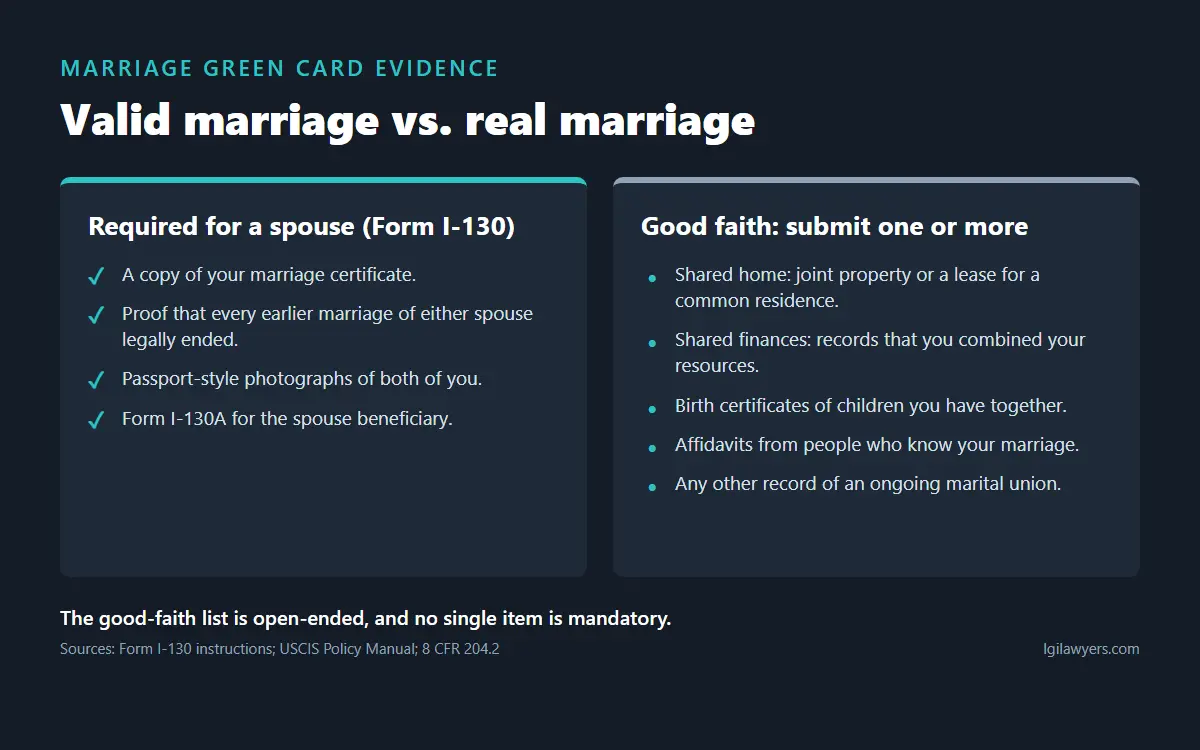
Start by separating what USCIS requires from what it recommends. The Form I-130 instructions require four things for a spouse:
- A copy of your marriage certificate.
- Proof that every earlier marriage of either spouse legally ended.
- Passport-style photographs of both of you.
- Form I-130A, a supplemental information form about the spouse beneficiary.
Those documents show that the marriage is valid. The Policy Manual calls a properly registered certificate prima facie evidence of validity, which means it is enough on that one point. Good faith is a separate point.
For good faith, the instructions say you “should submit one or more” of several types of documentation. The Policy Manual repeats the list, and a federal regulation uses the same categories for marriages entered during removal proceedings. The list is open-ended, and no single item is mandatory.
Shared home
The instructions name two kinds of records: documentation of joint ownership of property, and a lease showing joint tenancy of a common residence. They explain the lease in plain words: you both live at the same address together.
If only one name appears on the lease or deed, add other records that place you both at the address, with a short written explanation.
Shared finances
USCIS asks for documentation that you have combined your financial resources. It does not prescribe which documents. Elsewhere in the same chapter, the Policy Manual mentions joint bank accounts, joint tax returns, and joint utility bills as signs of shared finances.
Choose records that cover a period of time, such as several months of statements, over a single page that shows only that an account exists.
Children together
Birth certificates of children born to you and your spouse are on the list. A couple without children simply relies on the other categories, because the list is not a checklist.
Statements from people who know you
Sworn statements, called affidavits, come from third parties with personal knowledge of your marriage. The instructions require each affidavit to contain:
- The full name and address of the person making it.
- That person’s date and place of birth.
- Complete details explaining how the person knows about your marriage.
The regulation adds two cautions. USCIS may require the person to testify before an immigration officer. And affidavits should be supported, where possible, by documents. Statements work best as support for records, and poorly as a substitute for them.
The last category is the widest: any other relevant documentation that shows an ongoing marital union.
If you do not have the usual documents
Plenty of real couples have thin paperwork. One spouse may live abroad, or the lease may be in a relative’s name.
The rules leave room for that. Because the list is open-ended, a missing item is not automatically a failed case.
Living apart is the clearest example. The Policy Manual says that if spouses live separately but are not legally separated, USCIS may not deny the petition merely for that reason. Officers then look at when the separation began, how long it has lasted, and whether you still support each other and any children.
Being asked to document your own marriage can feel intrusive, and a gap in the file can feel like an accusation. It is not one. The Policy Manual states that failing to demonstrate a bona fide marriage does not, by itself, mean the marriage is fraudulent.
So explain each gap in writing, and replace the missing document with whatever does exist. An unexplained absence leaves the officer to guess.
Why the first filing matters more in 2026
Until this year, a thin filing usually drew a letter. USCIS would send a Request for Evidence (RFE), which lists what is missing. Or it would send a Notice of Intent to Deny (NOID), which gives you a chance to respond before a decision.
That is no longer a safe assumption. On August 5, 2026, USCIS issued Policy Alert PA-2026-05. It restores officers’ “full discretion to deny” a request without first issuing an RFE or NOID. The policy took effect immediately, and it applies to cases already pending on that date.
The updated Policy Manual chapter on evidence spells it out. USCIS may deny when required initial evidence is missing or when the evidence submitted does not show eligibility.
The same chapter tells officers not to avoid an RFE or NOID when one is needed. For spouse petitions, the Policy Manual still says USCIS may issue either notice or hold an interview when evidence falls short.
What changed is the guarantee. You can no longer count on a second chance, and a denial sets the case back on top of ordinary green card delays. Before filing, review the packet as if no one will write back to ask for more.
What happens at the interview
Will there be an interview? For a spouse applying inside the United States, usually yes. The Policy Manual’s interview guidelines say every adjustment applicant must be interviewed unless USCIS waives it. In family cases, USCIS generally requires the petitioner to appear too.
The officer uses the interview to verify what the application says and to let you correct answers that have changed.
When USCIS interviews both spouses, it may do so together or separately. The Policy Manual chapter on spouses gives USCIS that option. Whether an officer uses it in your case is not something anyone can promise in advance.
The most reliable preparation is plain: reread together everything you filed. The Form I-485 instructions and the I-130 instructions say USCIS may request the original of any document you sent as a copy, so keep those originals at hand.
Conditional residence when the marriage is under two years old
A recent marriage leads to a different kind of green card. The measuring date surprises many couples.
Under the conditional residence statute, residence is conditional if the marriage began less than 24 months before the day the spouse becomes a resident. The clock stops on the day residence is granted, not the day the petition is approved.
A conditional green card is valid for two years, and USCIS does not renew it. To keep permanent residence, you and your spouse file Form I-751, the petition to remove the conditions.
The joint filing window is the 90 days before the second anniversary of becoming a resident. USCIS may reject a petition filed before the window opens. The statute accepts a late filing only for good cause and extenuating circumstances.
The evidence is the same kind you gathered the first time, so keep saving joint records after approval.
What makes an officer look closer
Some facts lead USCIS to examine a marriage more carefully. The Policy Manual lists situations in which USCIS requires an interview on a spouse petition, including:
- The evidence is insufficient to decide whether the marriage is bona fide.
- The record contains material inconsistencies or derogatory information.
- The petitioner previously filed a spouse petition for a different person.
- Either spouse was part of an earlier spouse petition that was denied, revoked, or withdrawn.
- The marriage took place while the beneficiary was in removal proceedings.
A marriage during removal proceedings also raises the standard of proof to “clear and convincing evidence,” a higher bar than the usual one. Our guide to getting a green card during deportation proceedings covers that situation.
The most serious item is a past fraud finding. Federal law bars approval of any later petition for a person who attempted or conspired to marry to evade immigration law. Under the regulation, the bar applies even if the person received no benefit and was never convicted or prosecuted.
The bar depends on evidence in the record. The regulation requires that the evidence of the attempt or conspiracy be contained in the person’s file. The Policy Manual says USCIS must show substantial and probative evidence of marriage fraud, gives the petitioner an opportunity to overcome the finding, and denies the petition if the petitioner cannot.
If any of these facts is part of your history, address it in the filing itself. An attorney should review the earlier case before you file a new one.
How the affidavit of support fits in
Proof of the marriage is not the only document the petitioner signs. The sponsoring spouse also completes Form I-864, the Affidavit of Support, a financial commitment to the immigrating spouse.
USCIS published a new edition of that form on August 31, 2026. Since October 1, 2026, it accepts only that edition, dated 08/24/26. The new edition authorizes USCIS to request information from consumer reporting agencies, including credit reports and scores. We explain what sponsors authorize on Form I-864 and how a credit freeze can delay a case. Our guide to the public charge rule explains the broader financial review.
One more 2026 document affects spouses who adjust inside the United States. In a memorandum dated May 21, 2026, USCIS reminded officers that adjustment of status is discretionary.
The memo treats failing to depart as expected, and trying to avoid the consular process, as adverse factors an applicant may need to offset. It also tells officers to decide case by case and to weigh positive factors such as family ties. We explain it in our article on the USCIS policy on adjustment of status.
Every case is different, and the right evidence for one couple may be the wrong emphasis for another.
Frequently asked questions
Is my marriage certificate enough?
No. The certificate shows that your marriage is legally valid, and USCIS requires it. It does not show that you married in good faith. The I-130 instructions tell you to add at least one other type of documentation, such as a joint lease or combined finances.
What if we do not live together yet?
USCIS may not deny a petition merely because spouses live separately, as long as you are not legally separated. Officers consider when the separation began, how long it has lasted, and whether you support each other. Explain the reason in writing and document the contact and support between you.
Do we need a joint bank account?
No specific document is required. A joint account is one example of combined financial resources, which is one category on an open-ended list. If you keep money separate, other records can show a shared financial life.
What if we married recently?
A recent marriage does not prevent approval. If you have been married less than 24 months on the day residence is granted, the green card is conditional for two years. You and your spouse then file Form I-751 in the 90 days before the second anniversary.
Can my past visa overstay affect the case?
The law answers part of this question. The spouse of a U.S. citizen is an “immediate relative” under INA 201(b). INA 245(c)(2) excludes immediate relatives from the bar that applies to people who are out of status on the filing date or who failed to keep lawful status. That exception does not cover the spouse of a permanent resident, and INA 245(a) still requires, among other things, that the applicant was inspected and admitted or paroled.
Adjustment of status is also discretionary. The May 21, 2026 memorandum calls a failure to depart as expected “highly relevant” to that decision and tells officers to weigh all positive and negative factors, including family ties and immigration history. The memo does not address spouses of U.S. citizens specifically. Speak with an immigration attorney before you file.
The file you send is the case you have
In 2026 the first filing is closer to a final version than a draft. The same records will serve you again at the interview and, for recent marriages, two years later.
At Law Group International, attorneys Khalid Shekib and Daniela Lucena prepare marriage-based cases for couples across Virginia, Washington D.C., and Maryland, in English and Spanish. A review of your evidence before filing costs less time than rebuilding a denied case.
Ready to prepare your case with an experienced immigration team?
Schedule a consultationKhalid Shekib & Daniela Lucena · Law Group International
Offices in Alexandria, VAThis article provides general information and is not legal advice. Reading it does not create an attorney-client relationship with Law Group International. Immigration law changes often and every case is different, so speak with an immigration attorney about your own situation.
Sources
- USCIS, Form I-130, Petition for Alien Relative
- USCIS, Instructions for Form I-130 (edition 04/01/24)
- USCIS, Instructions for Form I-485
- USCIS Policy Manual, Volume 6, Part B, Chapter 6, Spouses
- USCIS Policy Manual, Volume 6, Part B, Chapter 5, Adjudication of Family-Based Petitions
- USCIS Policy Manual, Volume 7, Part A, Chapter 5, Interview Guidelines
- USCIS Policy Manual, Volume 1, Part E, Chapter 6, Evidence
- USCIS, Policy Alert PA-2026-05, Evidence, Requests for Evidence, and Notices of Intent to Deny, August 5, 2026
- USCIS, Policy Memorandum PM-602-0199, May 21, 2026
- 8 CFR 204.2, petitions for relatives
- Immigration and Nationality Act section 204(c), 8 U.S.C. 1154(c)
- Immigration and Nationality Act section 201(b), 8 U.S.C. 1151(b)
- Immigration and Nationality Act section 245(a) and (c), 8 U.S.C. 1255
- Immigration and Nationality Act section 216, 8 U.S.C. 1186a
- USCIS, Form I-751, Petition to Remove Conditions on Residence
- USCIS, Conditional Permanent Residence
- USCIS, Form I-864, Affidavit of Support
- USCIS, Fee Calculator
Last updated: October 2026