

What to Do If ICE Comes to Your Door: Know Your Rights in 2025
In 2025, ICE arrests doubled nationwide, according to reporting from NBC News. During the recent government shutdown, ICE intensified operations in neighborhoods, apartment buildings, workplaces, and public spaces, part of what analysts refer to as the administration’s “mass deportation playbook.”
If you’ve noticed more ICE activity in your community, you’re not imagining it. Families across Virginia, DC, and Maryland are experiencing an increase in home visits, workplace checks, and street encounters.
But here is the most important truth: You have constitutional rights, regardless of your immigration status. These rights protect everyone in the United States, citizens, visa holders, and undocumented immigrants alike.
The deportation defense attorneys at Law Group International have represented families through some of the most challenging enforcement periods. We understand the fear, but we also know that information and preparation can protect you.
In this guide, you will learn:
- Exactly what to do, step by step, if ICE comes to your door
- The difference between a judicial warrant and an ICE administrative warrant
- What to say (and what not to say)
- What documents never to sign
- How to create a family emergency plan
Your constitutional rights apply to everyone
The Constitution Protects Everyone on U.S. Soil
The Fourth and Fifth Amendments of the U.S. Constitution protect all people inside the United States, citizens and non-citizens alike. The Supreme Court affirmed this principle in Zadvydas v. Davis (2001).
| THE CONSTITUTION PROTECTS YOU
4th Amendment: “The right of the people to be secure in their persons, houses, papers, and effects, against unreasonable searches and seizures, shall not be violated.” 5th Amendment: “No person… shall be compelled in any criminal case to be a witness against himself.” These protections apply to EVERYONE, regardless of immigration status. |
What This Means When ICE Knocks
Your constitutional rights give you the power to:
- Refuse to open the door unless ICE presents a judicial warrant
- Remain silent and refuse to answer questions about your immigration status
- Request to see any warrant before opening your door
- Refuse to sign documents without legal advice
- Ask for an attorney before answering questions
Step-by-Step: What to Do When ICE Knocks
Step 1: Do not open the door
ICE cannot enter your home without your consent or a judicial warrant signed by a judge.
WHY THIS MATTERS
Opening your door—even slightly—may be taken as consent to enter. ICE agents may position themselves in a way that allows them to see inside your home and claim probable cause.
WHAT TO DO
- Keep the door closed and locked
- Speak through the door or a window
- Say clearly: “I do not consent to entry. Please slide the warrant under the door.”
- Do not open the door to inspect the warrant
Step 2: Ask to See the Warrant
There are two types of warrants:
| Characteristic | Judicial Warrant | ICE Administrative Warrant |
| Signed by | Federal or state judge | ICE officer |
| Form number | Varies | I-200 or I-205 |
| Authorizes forced entry | YES | NO |
| What to do | They may legally enter | Do NOT open—no authority to enter |
| How to identify | Judge’s signature, court seal | Signed only by ICE officer |
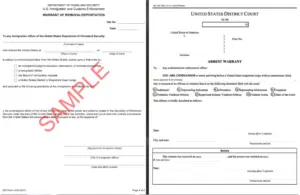
(Image Source: NJ.com)
CRITICAL: KNOW THE DIFFERENCE
An ICE administrative warrant (Form I-200 or I-205) is NOT the same as a judicial warrant.
Administrative warrants:
- Are signed by ICE officers—not judges
- Do NOT authorize forced entry into your home
Only a judicial warrant signed by a judge gives ICE legal authority to enter without your consent.
If you cannot confirm the warrant is judicial, do NOT open the door.
Step 3: Exercise Your Right to Remain Silent
| MEMORIZE THIS PHRASE
“I am exercising my right to remain silent. I do not wish to answer questions without my attorney present.” |
Questions you should NOT answer:
- Where were you born?
- What is your immigration status?
- How did you enter the country?
- Do you have papers?
- How long have you been in the U.S.?
- Where do you work?
You may state your name if required by local law.
IMPORTANT: Remaining silent is not lying. Lying to an ICE agent can lead to criminal charges and harm your immigration case.
You may say:
- “I choose not to answer that question.”
- Or simply remain silent after asserting your rights.
Step 4: Do Not Sign Anything
ICE may present documents intended to waive your rights.
Common documents include:
- Voluntary Departure: waives right to a hearing
- Stipulated Removal Order: agrees to deportation without a hearing
- Notice to Appear (NTA): generally safe to sign, but read carefully
- Any document in English you cannot fully understand
RULE OF THUMB: If you don’t understand it completely, do NOT sign it. Say: “I do not wish to sign anything without first consulting with my attorney.” Law Group International has seen cases where one signature eliminated all legal options. Don’t let this scenario happen to you.
Step 5: Document the Encounter
Documentation can be essential for your deportation defense case.
WHAT TO DOCUMENT
- Date and time of encounter
- Number of ICE agents
- Names and badge numbers (if visible)
- What agents said
- Whether a warrant was shown (and which type)
- Any use or threat of force
- Names of witnesses
- Vehicle descriptions and license plates
HOW TO DOCUMENT
- Have a family member or neighbor record from a safe distance
- Write everything down immediately after the encounter
- Take photos of documents left behind
- Save any voicemails or communications
Share all documentation with your attorney at Law Group International as soon as possible.
Special Situations: Workplace, Traffic Stops, Public Spaces
ICE encounters do not always happen at home. They can occur at work, while driving, or in public spaces. In every situation, your constitutional rights remain in effect, and knowing how to respond can protect you and your family.
If ICE Comes to Your Workplace
ICE needs a judicial warrant to enter non-public areas of a workplace, such as back offices, storage rooms, or employee-only spaces. Employers can allow ICE to enter these areas, but they shouldn’t do so without consulting a lawyer.
Even at work, your rights still apply. You are not required to respond to inquiries about your immigration status, and any attempts to flee or conceal yourself could potentially backfire against you.
YOUR RIGHTS AT WORK
Public vs. Private Areas:
- PUBLIC areas (lobby, sales floor): ICE may enter without permission.
- PRIVATE areas (offices, break rooms, employee-only areas): Require a judicial warrant or employer consent.
What Your Employer Can and Cannot Do:
- An employer cannot be forced to assist ICE without a judicial warrant.
- An employer can provide voluntary consent for ICE to enter private areas (but should not).
- An employer cannot retaliate against you for exercising your legal rights.
If ICE Arrives at Your Workplace:
- Do not run; this can be used as evidence of wrongdoing.
- Stay calm and walk (do not run) to a private space if possible.
- State clearly, “I am exercising my right to remain silent.”
- Do not answer questions about your immigration status or your coworkers.
- Ask, “Am I free to leave?”
- Contact a deportation defense attorney immediately.
Law Group International recommends that all employers in Virginia, DC, and Maryland establish a protocol for ICE visits. Ask your employer whether such a policy exists.
If ICE Stops You While Driving
During a traffic stop, you are required to provide certain vehicle-related documents. However, you are not required to answer immigration-related questions, and you should never consent to a search of your vehicle without a warrant.
TRAFFIC STOP RIGHTS
What You MUST Provide:
- Driver’s license (or state-issued ID in some states)
- Vehicle registration
- Proof of insurance
What You Do NOT Have to Provide or Answer:
- Your immigration status
- Your country of birth
- How long you’ve been in the United States
- Details about your travel beyond basic questions
Key Phrases to Use:
- “I do not consent to a search of my vehicle.”
- “Am I free to go?”
- “I am exercising my right to remain silent.”
WARNING: In certain states near the U.S. border, Border Patrol has expanded authority at immigration checkpoints. Know the laws that apply in your location. Consult the deportation defense attorneys at Law Group International for guidance specific to Virginia, DC, and Maryland.
If ICE Approaches You in Public
ICE agents may approach you on the street, in a parking lot, at a bus stop, or in other public areas. Your first step is always to ask: “Am I free to leave?” If the agent answers yes, you are not being detained. If they answer no, then you are detained—but you still have rights.
PUBLIC ENCOUNTER PROTOCOL
Step 1: Ask, “Am I free to leave?”
If YES:
- Walk away calmly
- Do not run
- Do not engage or answer questions while leaving
- Go somewhere safe and contact an attorney
If NO (you are being detained):
- Say clearly, “I am exercising my right to remain silent.”
- Ask, “What is the basis for detaining me?”
- Do not physically resist
- Do not answer questions about immigration status
- Request to speak with an attorney
- Memorize badge numbers, names, and physical descriptions of the agents
NEVER:
- Run from ICE agents
- Physically resist arrest
- Provide false information
- Consent to any search
Remember: Being detained is not the same as being arrested. You may still have legal options, and the actions you take in these moments matter. Contact the deportation defense team at Law Group International immediately to protect your rights.
ICE Encounters: Frequently Asked Questions
Can ICE break down my door?
Only if they have a judicial warrant signed by a judge. An administrative ICE warrant (Form I-200 or I-205) does NOT authorize forced entry into your home. ICE can’t break down the door if you don’t open it and they only have an admin warrant. If they do have a judicial warrant signed by a federal or state judge, they are permitted to use force to enter. This is why it is essential to ask to see the warrant before opening your door.
What if ICE says they have a warrant but won’t show it?
If ICE claims to have a warrant but refuses to show it, do not open the door. A valid warrant can always be slid under the door or held up to a window for verification. If agents refuse to present the warrant, it is very likely they do not have a judicial warrant authorizing entry. You should clearly state, “Please slide the warrant under the door so I can verify it is signed by a judge,” and if they still refuse, keep the door closed and contact a deportation defense attorney immediately.
Can I record ICE agents?
Yes, you have the legal right to record ICE agents in public spaces and from your own property, as this is protected by the First Amendment. While recording, you must not interfere with or obstruct their activities, and you should maintain a safe distance and remain calm. Such recordings can later serve as valuable evidence in your deportation defense case.
What if I live with someone who has a deportation order?
If ICE has a warrant for a specific person living in your home, opening the door may allow agents to enter and look for that individual, placing everyone in the household at potential risk. You still have the right to keep the door closed and to refuse to answer questions about who lives in your home. The person with the deportation order should also remain silent. Every household should have an emergency plan in place, and the attorneys Khalid and Daniela at Law Group International can help your family create a tailored protection strategy.
Should I carry my immigration documents with me?
If you have valid immigration documents such as a green card, visa, or work permit, carrying copies (not originals) can help quickly establish your status during an ICE encounter. Originals should be stored safely to avoid loss or confiscation. If you do not have valid documents, exercise your right to remain silent regarding your immigration status until you speak with an attorney. A deportation defense lawyer can advise you on what is safest to carry in your specific situation.
What happens to my children if I’m arrested by ICE?
Planning ahead is crucial because ICE policies regarding childcare considerations are inconsistently applied. You should designate a trusted emergency contact who can pick up your children, provide that person with written authorization to make decisions for them, and ensure school records list approved contacts. Schools can’t release kids to ICE, but they must know who can care for them. The deportation defense team at Law Group International can help you develop a comprehensive emergency plan to protect your children.
Create Your Emergency Plan Today
An ICE encounter can happen without warning, and having a well-prepared emergency plan can protect your family, your rights, and your future. Your plan should be simple, accessible, and understood by everyone in your household. The following checklist will help you prepare all essential documents, communication steps, legal resources, financial arrangements, and practice routines so that you are ready before an emergency occurs. Completing this plan now can make a critical difference during a stressful situation.
Emergency Preparedness Checklist
DOCUMENTS
- Copy of all immigration documents stored in a secure location (not just at home)
- Copies kept with a trusted family member, friend, or attorney
- Photos of all documents saved to your phone and cloud storage
- Children’s birth certificates, passports, and school records organized
- Important contact information written down on paper (not only in your phone)
FAMILY COMMUNICATION
- Emergency contact card prepared for each family member
- Designated person assigned to care for your children if you are detained
- Notarized letter authorizing that person to make decisions for your children
- School emergency forms updated with approved pickup contacts
- Family meeting held to explain the plan in age-appropriate language
LEGAL PREPARATION
- Deportation defense attorney’s phone number memorized
- “Know Your Rights” card kept in your wallet
- Local rapid-response hotline number saved
- A-Number (if applicable) memorized
- Copies of pending applications or case documents easily accessible
FINANCIAL
- Emergency fund that a trusted person can access
- List of bills and accounts shared with that trusted person
- Power of attorney prepared, if desired, for financial or legal decisions
PRACTICE
- Practice key phrases regularly with all family members
- Children know what to do, who to call, and where to go
- Everyone knows where important documents and backups are stored
Memorize This Phrase
THE PHRASE THAT PROTECTS YOU
“I do not consent to entry. I am exercising my right to remain silent. I want to speak to my attorney. I do not consent to a search.”
Practice this phrase until you can say it calmly under pressure. Every adult in your household should memorize it.
Emergency Contact Card Template
CUT OUT AND CARRY IN YOUR WALLET
EMERGENCY CONTACT CARD
My Attorney: ________________________
Phone: _____________________________
Emergency Contact #1: ________________
Phone: _____________________________
Emergency Contact #2: ________________
Phone: _____________________________
My A-Number: ________________________
In case of arrest, contact:
Law Group International
Deportation Defense
[XXX-XXX-XXXX]
I am exercising my 5th Amendment right to remain silent. I do not consent to a search. I want to speak with my attorney.
Protect Yourself and Your Family
ICE encounters can be overwhelming, frightening, and unexpected—but knowledge and preparation give you power. Understanding your rights, having a plan in place, and knowing who to call can dramatically change the outcome of a difficult situation. Before you move forward, remember these key takeaways:
KEY TAKEAWAYS:
- You have constitutional rights regardless of immigration status
- Never open the door without first seeing a judicial warrant signed by a judge
- Exercise your right to remain silent—anything you say can be used against you
- Do not sign anything without speaking to a deportation defense attorney
- Create an emergency plan before you need it
- Practice the key protective phrases with your family
Your best defense is preparation. Protecting your home and your loved ones begins with taking action today, not when ICE is already at your door.
PROTECT YOUR FAMILY NOW
ICE arrests have doubled in 2025. Don’t wait until agents show up unannounced.
The deportation defense attorneys at Law Group International, Khalid and Daniela, have defended families across Virginia, DC, and Maryland during some of the most challenging enforcement periods. We understand what is at stake for you, your children, and your future.
WE PROVIDE:
- “Know Your Rights” family consultations
- Personalized emergency plan creation
- 24/7 emergency response for ICE arrests
- Aggressive deportation defense representation
- Consultations available in English and Spanish
Don’t face ICE alone. Your family’s safety is our top priority. Schedule a confidential consultation today. Consultas en español disponibles.