

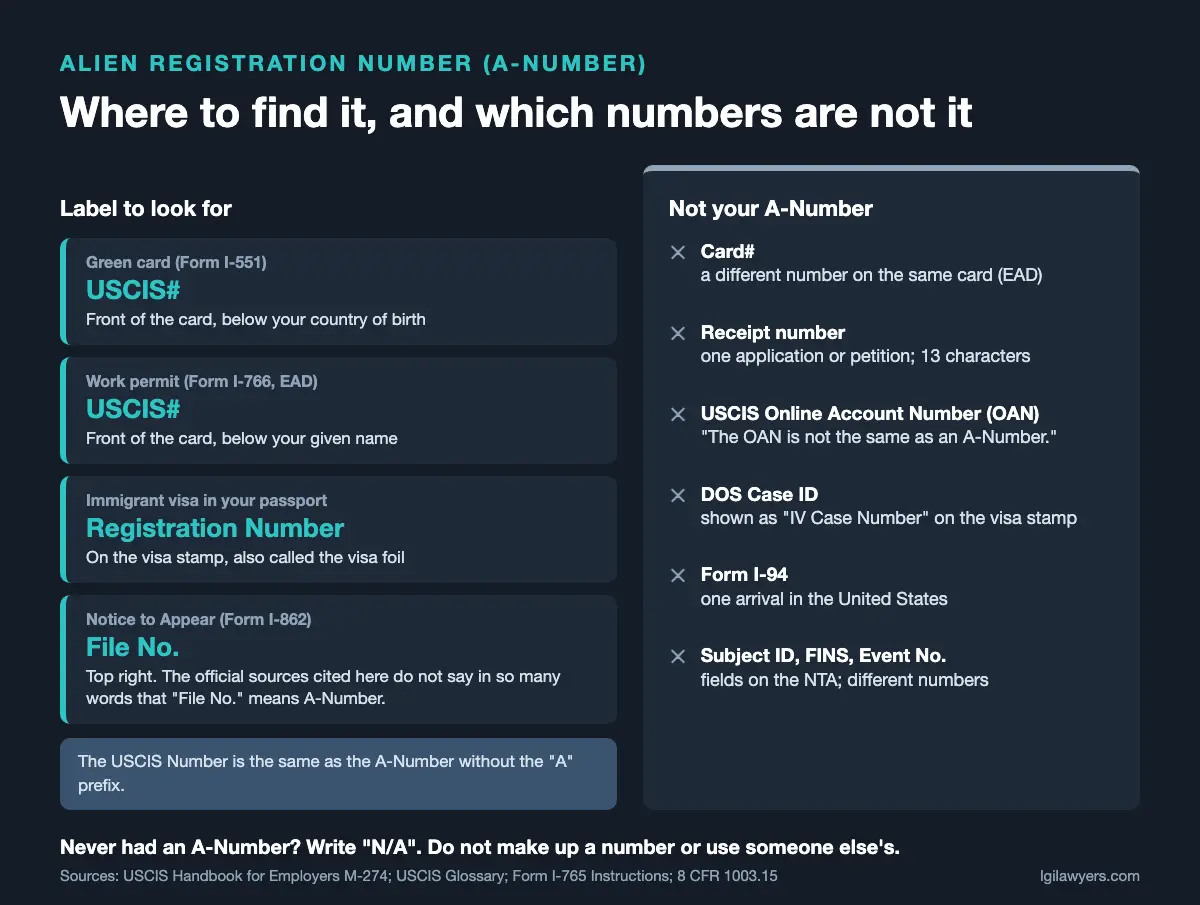
On a green card or a work permit, your A-Number is the number printed under “USCIS#.” On an immigrant visa stamp, it appears as the “Registration Number.”
That number is your alien registration number, the file number the U.S. government uses to track your immigration history. U.S. Citizenship and Immigration Services (USCIS), the agency that handles green cards and work permits, defines it as “a unique seven-, eight- or nine-digit number that the Department of Homeland Security assigned to an alien.”
The Department of Homeland Security (DHS) is the federal department that includes USCIS, U.S. Immigration and Customs Enforcement (ICE) and U.S. Customs and Border Protection (CBP).
Hunting for a number with a form half filled in is stressful. The good news is that it is probably already in your folder, just under a different label.
What the alien registration number (A-Number) is
The A-Number is your personal identifier in the immigration system. The instructions for Form I-765 say it plainly: “We use your A-Number to identify your immigration records.”
It is usually written as the letter A followed by 8 or 9 digits.
Your paper file follows the same logic. USCIS explains that Alien Files, or “A-Files,” are individual files identified by the A-Number.
Not everyone has one. USCIS forms ask for the “Alien Registration Number (A-Number) (if any).” The instructions add: “If you do not have an A-Number, type or print ‘N/A.'” Check your papers before you write “N/A.”
Where to find your A-Number, document by document
Each official document labels the A-Number differently. The table lists only labels confirmed on official samples from USCIS or the Executive Office for Immigration Review (EOIR), which runs the immigration courts.
| Document | Label to look for | Where it is |
|---|---|---|
| Green card (Form I-551, Permanent Resident Card) | USCIS# | Front of the card, below your country of birth |
| Work permit (Form I-766, Employment Authorization Document or EAD) | USCIS# | Front of the card, below your given name |
| Immigrant visa in your passport | Registration Number | On the visa stamp, also called the visa foil |
| Notice to Appear (Form I-862) and immigration court papers | File No. | Top right of the Notice to Appear (see below) |
Green card
USCIS’s Handbook for Employers (M-274) shows a sample of the current green card. The number sits under the label “USCIS#.” The same handbook confirms that “the USCIS Number is the same as the A-Number without the ‘A’ prefix.”
On the 2010 version of the card, USCIS notes that the number also appears on the back.
Work permit (EAD)
An EAD is the card that shows you are allowed to work in the United States. On the official sample, the A-Number again appears as “USCIS#.” Do not confuse it with the “Card#” field on the same card. The Card# is a different number, and it is not your A-Number.
Immigrant visa stamp
If you entered the United States as a new immigrant, look at the visa in your passport. USCIS states: “Your A-Number is identified as the Registration Number on your visa stamp.” It also appears at the top of the immigrant data summary the consulate gave you.
Notice to Appear and court papers
A Notice to Appear (NTA) is the DHS document that starts deportation proceedings, called removal proceedings, before an immigration judge. Federal rules require DHS to include “the alien’s registration number” in it, under 8 CFR 1003.15(c).
On the official form, look for the “File No.” box at the top right. In the sample documents EOIR publishes for its model hearing program, that box holds the same number that the court papers show as “A 123-456-789.” Federal rules require the NTA to include your registration number, but the official sources cited here do not say in so many words that “File No.” means A-Number. The NTA also has “Subject ID,” “FINS” and “Event No.” fields, which are different numbers.
EOIR’s online case system adds that the A-Number “is printed in all DHS and EOIR correspondence.”
USCIS letters and notices
USCIS form instructions say your A-Number “can be found on correspondence you have received from the Department of Homeland Security (DHS) or USCIS.” Not every notice labels it, though. The official sample of Form I-797, Notice of Action, highlights the receipt number instead.
Not sure which number on a letter is your A-Number? Compare it with your green card, EAD or court papers before you use it on a form.
How the A-Number differs from other immigration numbers
The A-Number belongs to you as a person. Most of the other numbers belong to a single application, account or trip.
| Number | What it identifies | What it looks like | Is it your A-Number? |
|---|---|---|---|
| USCIS Number (USCIS#) | You, on green cards and EADs | Digits only | Yes. It is the same number without the “A” |
| Receipt number | One application or petition | 13 characters: 3 letters and 10 numbers, such as IOE or MSC plus digits | No |
| USCIS Online Account Number (OAN) | Your USCIS online account | Shown in your account profile or on the Account Access Notice | No |
| Department of State (DOS) Case ID | Your immigrant visa case | 3 letters and 9 or 10 numbers | No |
| Form I-94 | One arrival in the United States | Arrival and departure record from U.S. Customs and Border Protection (CBP) | No |
A receipt number tracks one application, and you find it on the notices of action USCIS sends you.
The USCIS Online Account Number (OAN) works differently. Form instructions say you only have one “if you previously filed a form that has a receipt number that begins with IOE.” They also say: “The OAN is not the same as an A-Number.”
The DOS Case ID comes from the Department of State. On the visa stamp it appears as “IV Case Number,” with two extra digits at the end, while your A-Number is the “Registration Number.”
When you will need your A-Number
Do you have a form, a hearing or a move coming up? Then you will likely need it.
- USCIS forms. Form I-90 (to replace a green card) asks for it in Part 1, and Form I-765 (to apply for a work permit) in Part 2. If you add extra sheets, USCIS asks you to write your name and A-Number at the top of each one.
- Immigration court. EOIR’s phone line and online case system both ask for your A-Number in a set format, which our guide on how to check your immigration court date explains.
- Change of address. Form AR-11, the change of address form USCIS uses, includes a field for the A-Number (if you have one).
- Registration. Our articles explain the mandatory registration requirement and who needs to register under the new immigrant registry rule.
Families looking for a detained relative may also be asked for it. Our article on the ICE detainee locator covers what to do when a person does not appear in the search.
What to do if you can’t find your A-Number or never had one
Start with your own papers. Then, if needed, ask USCIS for your file.
- Check every card and letter you have kept, using the labels in the table above.
- Request your records from USCIS. The Freedom of Information Act (FOIA) is the federal law that lets you ask for your own immigration records. USCIS directs requests to its online system, USCIS FIRST, which works through a USCIS online account. If USCIS releases records, you can download them from that account.
- Say so if you have a hearing. USCIS states that it will prioritize a FOIA request for a scheduled immigration hearing if you include proof, such as your Notice to Appear.
You do not need your A-Number to file the request. USCIS treats it as an optional identifier that can help it locate your records.
If you had a deportation case or another immigration matter years ago, speak with an immigration attorney before you file anything new.
If you have never had an A-Number, USCIS instructions tell you to write “N/A” in that field. Do not make up a number or use someone else’s.
Frequently asked questions
What is an A-File, and how does it relate to my A-Number?
An A-File is your individual immigration file. USCIS explains that A-Files are “identified by the subject’s Alien Registration Number.” According to USCIS, the government started issuing each person a unique A-Number in 1940 and began creating A-Files in 1944. If you see two different A-Numbers on your documents, ask an immigration attorney to review them before you file.
Is my USCIS number the same as my A-Number?
Yes. USCIS’s Handbook for Employers says the USCIS Number “is the same as the A-Number without the ‘A’ prefix.” On your green card or EAD, it is the number under “USCIS#.”
Do I have an A-Number if I came on a tourist visa?
USCIS forms ask for the A-Number “if any,” so not everyone has one, and the official sources do not give a simple rule by type of visa. If you have ever received a green card, a work permit, a USCIS notice or immigration court papers, check them first. If you still cannot tell, you can request your records through FOIA or speak with an immigration attorney.
How many digits does an A-Number have?
USCIS defines it as seven, eight or nine digits, usually written after the letter A.
Where is the A-Number on my work permit?
On the front of the EAD, under the label “USCIS#.” It is not the “Card#” field, which is a separate number.
Keep your A-Number with your records
Your A-Number ties your whole immigration file together. Keep a copy of it with your important papers. A photo of your card or notice, stored safely, can save you time on the next form or call.
Two numbers that do not match, a lost card or an old case are the moments when a second look helps. For people in Virginia, Washington D.C., and Maryland, attorneys Khalid Shekib and Daniela Lucena at Law Group International can review those records with you before you file.
Ready to prepare your case with an experienced immigration team?
Schedule a consultationKhalid Shekib & Daniela Lucena · Law Group International
Offices in Alexandria, VAThis article provides general information and is not legal advice. Reading it does not create an attorney-client relationship with Law Group International. Immigration law changes often and every case is different, so speak with an immigration attorney about your own situation.
Sources
- USCIS, Glossary (A-Number, USCIS Number, Receipt Number, USCIS Online Account Number, Arrival-Departure Record): https://www.uscis.gov/tools/glossary
- USCIS, Handbook for Employers M-274, 13.1 List A Documents (green card and EAD samples): https://www.uscis.gov/i-9-central/form-i-9-resources/handbook-for-employers-m-274/130-acceptable-documents-for-verifying-employment-authorization-and-identity/131-list-a-documents-that-establish-identity-and-employment-authorization
- USCIS, Handbook for Employers M-274, 3.0 Completing Section 1: https://www.uscis.gov/i-9-central/form-i-9-resources/handbook-for-employers-m-274/30-completing-section-1-employee-information-and-attestation
- USCIS, Commonly Used Immigration Documents (samples of Form I-797 and Form I-862): https://www.uscis.gov/save/current-user-agencies/commonly-used-immigration-documents
- USCIS, Immigrant Fee Payment: Tips on Finding Your A-Number and DOS Case ID: https://www.uscis.gov/forms/filing-fees/uscis-immigrant-fee/immigrant-fee-payment-tips-on-finding-your-a-number-and-dos-case-id
- USCIS, Form I-765 Instructions: https://www.uscis.gov/sites/default/files/document/forms/i-765instr.pdf
- USCIS, Form I-90 Instructions: https://www.uscis.gov/sites/default/files/document/forms/i-90instr.pdf
- USCIS, Form AR-11: https://www.uscis.gov/sites/default/files/document/forms/ar-11.pdf
- USCIS, A-Files Numbered Below 8 Million: https://www.uscis.gov/records/genealogy/historical-record-series/a-files-numbered-below-8-million
- USCIS, Request Records through the Freedom of Information Act or Privacy Act: https://www.uscis.gov/records/request-records-through-the-freedom-of-information-act-or-privacy-act
- USCIS FIRST: https://first.uscis.gov/
- 8 CFR 1003.15, Contents of the Notice to Appear: https://www.law.cornell.edu/cfr/text/8/1003.15
- EOIR, Automated Case Information: https://acis.eoir.justice.gov/en/
Last updated: November 2026