

Bond Hearings Eliminated in 2026: What to Do When ICE Denies Your Right to a Hearing
If you or a loved one has been detained by ICE in 2026, you may have been told that you have no right to a bond hearing. This is not a misunderstanding. It reflects a major policy change that has eliminated bond hearings for millions of immigrants across the United States.
Since early 2025, ICE has reclassified how it categorizes certain detained immigrants, effectively removing their eligibility for bond hearings before an immigration judge. Two federal appeals courts have now upheld this approach, and the legal landscape continues to shift.
But this is not the end of the road. Federal district courts across the country have pushed back against these policies, and legal options remain available for people who have been denied a bond hearing.
This guide from Law Group International explains what changed with bond hearings in 2026, what the courts are saying, and what legal options exist for detained immigrants and their families.
Why ICE Is Denying Bond Hearings in 2026
To understand the current situation, it helps to know how bond hearings have traditionally worked in immigration cases.
Under Section 236(a) of the Immigration and Nationality Act (INA), most immigrants detained by ICE have historically been entitled to appear before an immigration judge for a bond hearing. During that hearing, the judge evaluates whether the individual poses a danger to the community or a flight risk and decides whether to release them on bond while their case proceeds.
In early 2025, ICE issued an internal policy memorandum directing officers to classify certain detained immigrants differently. Rather than processing them under INA Section 236(a), which provides bond hearing eligibility, ICE began classifying individuals who entered the United States without inspection as “applicants for admission” under INA Section 235(b).
This distinction matters enormously. Section 235(b) governs the treatment of arriving aliens, and individuals classified under this provision are generally subject to mandatory detention without access to a bond hearing.
The practical effect is that immigrants who have lived in the United States for years, sometimes decades, are now being treated as though they arrived at the border yesterday. By reclassifying them as applicants for admission, ICE argues that these individuals were never formally “admitted” to the country, regardless of how long they have been here.
This reclassification was reinforced by the Board of Immigration Appeals (BIA) decision in Matter of Yajure-Hurtado, which supported ICE’s authority to make this determination. A subsequent federal court order in Maldonado Bautista further enforced the policy.
As a result, ICE offices across the country have stopped presenting many detained immigrants for bond hearings in immigration court. For affected individuals and their families, this means the traditional path to release while a case is pending has been closed.
What Courts Are Saying About Bond Hearing Elimination
The elimination of bond hearings has triggered significant legal conflict across the federal court system. The picture is complex, with different courts reaching different conclusions.
Circuit Court Decisions Supporting the Policy
On February 6, 2026, the Fifth Circuit Court of Appeals ruled in Buenrostro-Mendez that ICE has the authority to classify interior-arrested immigrants as applicants for admission under INA 235(b), thereby denying them bond hearings. This was the first federal appeals court to uphold the policy.
On March 26, 2026, the Eighth Circuit reached a similar conclusion in Herrera Avila v. Bondi, becoming the second appeals court to side with the government. The Eighth Circuit held that immigrants who entered without inspection may be treated as applicants for admission regardless of how long they have lived in the United States.
District Court Decisions Opposing the Policy
In contrast, more than 300 federal district court judges across the country have ruled against ICE’s reclassification policy. These courts have found that immigrants arrested in the interior of the country should be processed under INA 236(a) and are entitled to bond hearings.
This overwhelming majority of district court rulings demonstrates that the legal question is far from settled. Many of these cases have resulted in orders requiring ICE to provide bond hearings to specific detainees.
The Road to the Supreme Court
With two circuit courts now siding with the government and hundreds of district courts ruling the other way, the conditions are in place for the Supreme Court to take up this issue. Legal observers expect the Court to grant certiorari on a bond hearing case in the near future. Any Supreme Court decision would apply nationwide and could fundamentally reshape the legal landscape.
In the meantime, the law varies depending on where you are detained. Individuals in the Fifth and Eighth Circuits face a more challenging path, while those in other jurisdictions may still be able to obtain bond hearings through federal court intervention.
Legal Options If You Are Denied a Bond Hearing
Even when ICE denies a bond hearing, detained immigrants are not without legal recourse. Several legal tools remain available, and an experienced attorney can evaluate which strategy applies to your situation.
Habeas Corpus Petition in Federal Court
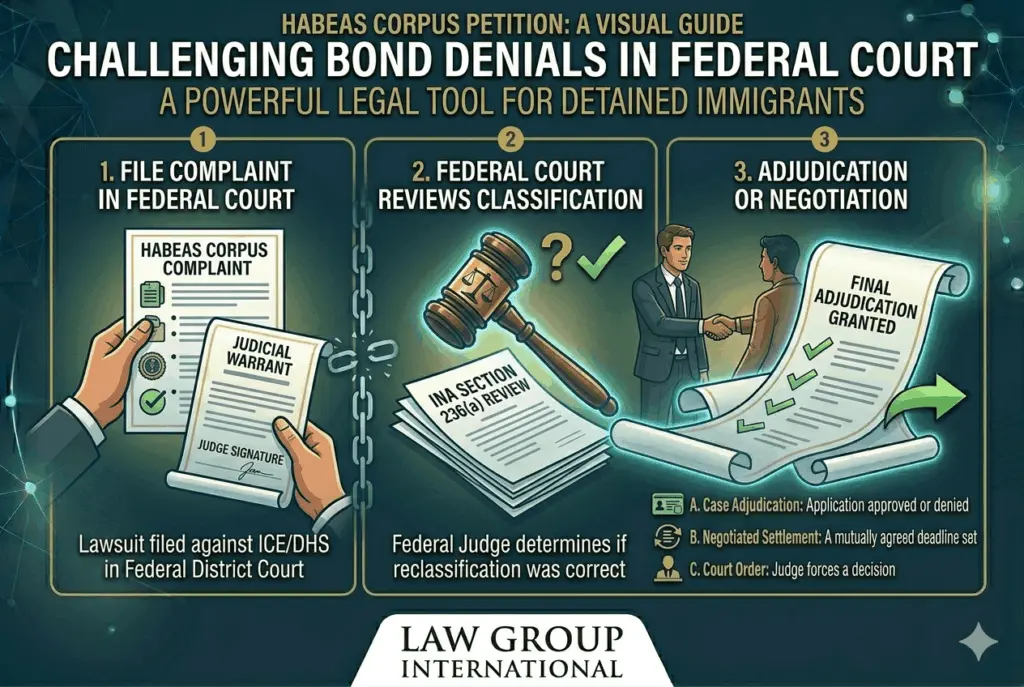
The most powerful tool available to challenge bond hearing denial is a habeas corpus petition filed in federal district court. A habeas petition asks a federal judge to review whether the government is lawfully detaining a person.
In the context of bond hearing denials, a habeas petition argues that ICE has incorrectly classified the detained person and that they are entitled to a bond hearing under INA 236(a). Federal judges in many districts have been granting these petitions, with success rates exceeding 90 percent in some jurisdictions.
Habeas corpus cases are filed in federal court, not immigration court. This means they require an attorney experienced in federal litigation.
Challenging the “Applicant for Admission” Classification
In some cases, an attorney can challenge the factual or legal basis for ICE’s classification of the detained person as an applicant for admission. If the individual can demonstrate a prior lawful entry, a grant of parole, or another basis for being treated under INA 236(a), the classification may be overturned.
Humanitarian Parole Request
Although humanitarian parole grants have become significantly more difficult to obtain in 2026, some detained individuals may still qualify based on urgent humanitarian reasons or a significant public benefit. Parole requests are submitted directly to ICE and do not require a court proceeding.
Writ of Mandamus for Unreasonable Delay
If ICE or USCIS is unreasonably delaying action on a pending application that could affect a detained person’s case, a writ of mandamus may be appropriate. This legal action asks a federal court to order the government to make a decision. While mandamus does not directly address bond, it can resolve underlying case delays that contribute to prolonged detention.
Why You Need a Federal Litigation Attorney for Bond Issues
Bond hearing challenges in 2026 are fundamentally different from how they worked in previous years. The shift from immigration court bond hearings to federal court litigation means that many detained immigrants now need a different kind of legal representation.
Immigration Court vs. Federal Court
Traditionally, bond hearings took place in immigration court, where an immigration judge could decide whether to release a detained person. In 2026, with bond hearings eliminated for many individuals, the path to release increasingly runs through federal district courts through habeas corpus petitions.
Federal courts operate under different rules, timelines, and procedures than immigration courts. Attorneys who handle these cases must be experienced in federal litigation, including filing complaints, arguing motions, and navigating federal procedural requirements.
What to Prepare for a Consultation
If you or a loved one has been denied a bond hearing, you should gather the following information before contacting an attorney:
- The detained person’s full name, A-Number (Alien Registration Number), and date of birth
- The name and location of the detention facility
- Any documents received from ICE, including the Notice to Appear (NTA)
- Information about how and when the person entered the United States
- Whether the person has any prior immigration history, including previous orders of removal
- Any pending immigration applications
Frequently Asked Questions
Can ICE hold me indefinitely without a bond hearing?
Under current policy, ICE is denying bond hearings to immigrants classified as applicants for admission under INA 235(b). However, the Constitution places limits on indefinite detention. A habeas corpus petition in federal court can challenge prolonged detention and may result in release or a court-ordered bond hearing.
Can I still request a bond hearing in immigration court?
It depends on your classification. If you entered the United States with inspection, meaning through an official port of entry with valid documentation, or if you hold certain prior statuses such as lawful permanent residency, you may still be eligible for a bond hearing before an immigration judge. Individuals classified under INA 235(b) are generally not eligible for immigration court bond hearings under the current policy but may seek relief through federal court.
What is a habeas corpus petition?
A habeas corpus petition is a legal action filed in federal district court that asks a judge to review whether the government is lawfully detaining someone. In bond hearing cases, the petition argues that the detained person has been incorrectly classified and should have access to a bond hearing. If the judge agrees, the court may order ICE to provide a hearing or release the individual.
How long does a habeas case take?
Timelines vary by jurisdiction and the complexity of the case. Some habeas petitions result in emergency hearings within days or weeks. Others may take several months to resolve. Because detention continues while the case proceeds, attorneys often file emergency motions requesting expedited review.
How much does it cost to challenge a bond denial?
Costs depend on the complexity of the case, attorney fees, and federal court filing fees. Many immigration attorneys offer consultations to assess whether federal court action is appropriate for your situation.
What if I entered with inspection: does this policy affect me?
If you entered the United States through an official port of entry with valid documentation, you are generally not subject to the INA 235(b) reclassification. You may still be eligible for a traditional bond hearing in immigration court. However, every case is different, and it is important to consult with an immigration attorney to understand your specific situation.
What about my U.S. citizen children?
Having U.S. citizen children does not automatically grant you the right to a bond hearing. However, family ties can be relevant in several ways: they may support arguments in a habeas petition, they are a factor judges consider when evaluating bond amounts, and they may be relevant for other forms of immigration relief such as cancellation of removal.
The Elimination of Bond Hearings Is Not the End of the Road
The elimination of bond hearings represents one of the most significant changes to immigration enforcement in 2026. For hundreds of thousands of detained immigrants and their families, this policy has created real fear and uncertainty.
But legal options remain. Federal courts continue to grant habeas petitions challenging bond hearing denials. Experienced attorneys are finding ways to secure hearings and release for their clients through federal litigation.
At Law Group International, federal court litigation is at the center of our immigration practice. Attorneys Khalid and Daniela file habeas corpus petitions, bond challenges, and other federal court actions on behalf of detained immigrants and their families in Virginia, Washington DC, and Maryland.
If you or someone you love has been denied a bond hearing, speaking with a federal litigation attorney can help you understand your options and take action.
Call (202) 590-3887 to schedule a consultation with Law Group International.