

Last updated: November 2026
One short paragraph would disappear from the federal immigration regulations: 8 CFR 214.1(c)(5), which tells U.S. Citizenship and Immigration Services (USCIS) to respect its own earlier approvals. The Department of Homeland Security (DHS) proposed that deletion in a proposed rule published on October 14, 2026. If adopted, it would end USCIS deference to prior approvals for every petition filed on Form I-129.
Nothing has changed yet. A proposed rule is a draft that DHS publishes for public comment before it decides whether to adopt a final version. The comment period ran until November 13, 2026.
The change matters to companies that sponsor H-1B, L-1, O-1 or TN workers, and to workers with an extension coming up. Until DHS publishes a final rule, the current regulation still applies, and that shapes how to file now.
USCIS deference to prior approvals today
Today, USCIS generally respects its earlier decision when nothing has changed. Deference means that an officer starts from the prior approval instead of reviewing eligibility from zero.
A federal regulation, 8 CFR 214.1(c)(5), sets the rule. “8 CFR” is Title 8 of the Code of Federal Regulations, where immigration rules are published. Form I-129 is the Petition for a Nonimmigrant Worker that employers file for temporary workers. When an I-129 involves the same parties and facts, “USCIS gives deference to its prior determination” of eligibility.
The regulation lists three exceptions. USCIS need not defer when:
- there was a material error in the prior approval;
- there has been a material change in circumstances or eligibility requirements; or
- there is new, material information that adversely impacts eligibility.
The USCIS Policy Manual, the agency’s official guidance for its officers, says the same. Its October 27, 2026 version states that officers “should defer” to a prior determination “where appropriate.” An officer who decides not to defer must acknowledge the prior approval in the denial or in a Request for Evidence (RFE). An RFE is a written request for more documents. The officer must also explain why and get a supervisor’s approval before deviating in the final decision.
Deference never meant automatic approval. Under the Policy Manual, the burden of proof stays with the petitioner, the employer that files.
What the proposed rule would change
DHS would remove and reserve paragraph (c)(5) of 8 CFR 214.1, so the deference rule would disappear from the regulations.
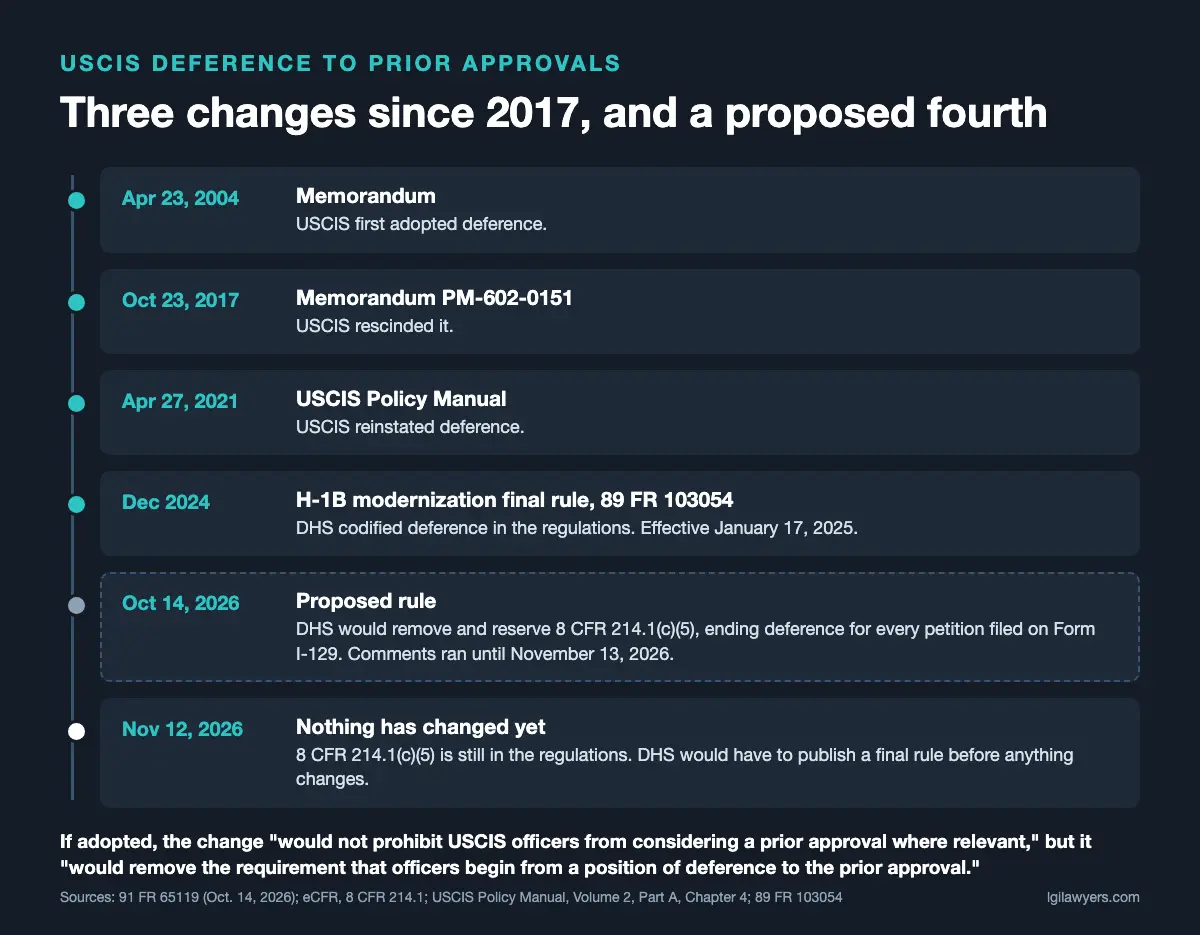
In DHS’s words, the change “would not prohibit USCIS officers from considering a prior approval where relevant.” Instead, it “would remove the requirement that officers begin from a position of deference to the prior approval.”
DHS also weighed a middle path. It considered rewriting the rule to say that USCIS “may give deference in its discretion.” DHS rejected that option because it “would likely create unnecessary confusion and uncertainty” for petitioners and officers.
USCIS would make “corresponding changes” to the Policy Manual only “if this proposed rule becomes final.” Until then, both remain in effect.
Which visa categories it would affect
The change would reach every benefit request filed on Form I-129. The proposal lists the classifications that use that form for an extension of stay, meaning a request to remain longer in the same status:
- E categories: E-1, E-2 and E-3;
- H categories: H-1B, H-1B1, H-2A, H-2B and H-3;
- L-1;
- O categories: O-1 and O-2;
- P categories: P-1, P-2, P-3, P-1S, P-2S and P-3S;
- Q-1 and R-1;
- TN.
Dependents are a separate case. According to the proposal, their extension requests may be filed on Form I-539, a different application.
If your workforce includes any of these categories, map out which workers have extensions due in the next 12 months.
Why DHS says the change is needed
DHS gives three reasons. First, it argues that deference “effectively shift[s] the burden” from the employer to the officer. Under the Immigration and Nationality Act, the burden belongs to the person asking for the benefit.
Second, DHS says deference may discourage officers from asking for more evidence. Its own analysis estimates that removing deference may raise the RFE rate by 2.9 percentage points. That would mean about 6,044 additional RFEs a year, at an estimated cost to petitioners of $133,987 a year.
Third, DHS points to site visit results, the inspections USCIS makes at employers’ workplaces. According to DHS, non-compliance or fraud at H-1B extension sites visited was 22.39 percent in fiscal years 2022 to 2025. In fiscal years 2018 to 2020, it was 16.77 percent. For L-1A, the category for transferred executives and managers, the figures were 24.46 percent and 18.37 percent.
DHS acknowledges that “other factors besides or in addition to deference” may explain those numbers. It also reports that denial rates showed no corresponding change when deference was off.
How deference has gone back and forth since 2017
USCIS first adopted deference in an April 23, 2004 memorandum. On October 23, 2017, USCIS rescinded it with memorandum PM-602-0151.
On April 27, 2021, USCIS reinstated deference in the Policy Manual. In December 2024, DHS codified it in the regulations through the H-1B modernization final rule, published in the Federal Register (FR) at 89 FR 103054 and effective January 17, 2025.
That makes three changes since 2017. The October 14, 2026 proposal would be a fourth, but it is still only a proposal. DHS admits that some of its statements now “represent a shift” from what it said in 2024.
How to prepare an extension that does not rely on deference
DHS itself expects employers to adjust. Its analysis says petitioners “may take additional steps to ensure that submissions are complete and well-organized at the outset, instead of merely relying on a prior approval.” Even today, the Policy Manual says the burden of proof in an extension “remains on the petitioner.”
According to the proposal, an extension filed on Form I-129 already has to include:
- evidence of continued eligibility for the classification;
- evidence that the worker maintained status;
- all other initial evidence required by the regulations and the Form I-129 instructions.
DHS says the goal is that petitions are approved only if eligibility is shown “based on evidence submitted in support of each petition.” An attorney can tell you which documents your category requires.
Changes are a second point. DHS says petitioners “may be less forthcoming” about reduced operations, lost contracts or altered duties if they believe a prior approval is binding. If something has changed since the last approval, talk to an attorney about how to present it in the extension.
Timing is the third point. For fiscal years 2022 to 2025, DHS reports median processing times averaging 76 days for petitions with an RFE and 12 days without one. Filing early can leave room for an RFE response.
A timely filing may also protect the worker, but only for a limited time. The proposal notes that a worker whose extension is still pending “may remain in the United States in an authorized period of stay.” Under 8 CFR 274a.12(b)(20), workers in the categories it lists may keep working for the same employer. That permission lasts up to 240 days after the authorized stay expires, and it ends if USCIS denies the extension first.
For the general steps before any renewal, see our guide to work permit renewals and visa extensions. Every case is different, so have an attorney review your specific extension.
What this proposal is not
The deference proposal is separate from other recent H-1B measures.
- The $100,000 payment. Proclamation 10973 restricts the entry of certain H-1B workers outside the United States unless the petition includes a $100,000 payment. Proclamation 11069 extended it until September 21, 2027. Check the current status of the payment on the USCIS H-1B page before you file.
- The weighted lottery. A final rule effective February 27, 2026 changed how USCIS selects registrations for the annual H-1B cap, the yearly limit Congress set for the category. The new process generally favors higher-skilled and higher-paid workers.
- The proposed H-1B fee. A separate proposed rule published August 25, 2026 would add a new fee for H-1B cap-subject petitions.
Before you budget or file, confirm which of these measures actually applies to your worker.
Frequently asked questions
Is the end of deference already in effect for my case?
No. As of November 12, 2026, the date this article was last checked, 8 CFR 214.1(c)(5) is still in the regulations and the Policy Manual still tells officers to defer where appropriate. DHS would have to publish a final rule in the Federal Register before anything changes.
Will this affect my extension that is already pending?
The proposal does not say how a final rule would treat petitions pending on its effective date. Today, 8 CFR 214.1(c)(5) is still in effect. If DHS publishes a final rule while your extension is pending, ask an attorney how it may affect your case.
Does this affect my green card process?
The proposal removes only 8 CFR 214.1(c)(5), which covers requests filed on Form I-129. It does not mention green card petitions. An H-1B extension is still filed on Form I-129, even if the worker is also in a green card process. If that is your situation, consult an attorney about how the change may affect it.
Will this change my visa appointment at a U.S. consulate?
The proposal does not say. It amends a DHS regulation on how USCIS reviews Form I-129 and does not mention consular visa decisions. The Policy Manual already says USCIS considers, but does not defer to, eligibility decisions made by the State Department or U.S. Customs and Border Protection (CBP).
What about my TN or O-1 extension?
Both are on the proposal’s list. If CBP first approved your TN at the border, the Policy Manual already says USCIS does not defer to that decision. A TN or O-1 extension filed with USCIS would lose deference only under a final rule.
Planning extensions while the rule is pending
The proposal does not change who qualifies for any I-129 category. It changes how much an earlier approval would help you prove it again.
Law Group International helps companies and workers in Virginia, Washington, D.C., and Maryland prepare nonimmigrant work visa petitions and extensions. Attorneys Khalid Shekib and Daniela Lucena can review your upcoming extensions and the evidence each one may need. Whatever DHS decides, a complete file is easier to defend.
Ready to prepare your case with an experienced immigration team?
Schedule a consultationKhalid Shekib & Daniela Lucena · Law Group International
Offices in Alexandria, VAThis article provides general information and is not legal advice. Reading it does not create an attorney-client relationship with Law Group International. Immigration law changes often and every case is different, so speak with an immigration attorney about your own situation.
Sources
- Federal Register, “Removing Deference to Prior USCIS Determinations of Eligibility,” 91 FR 65119 (Oct. 14, 2026)
- Regulations.gov, docket USCIS-2026-0529
- eCFR, 8 CFR 214.1
- USCIS Policy Manual, Volume 2, Part A, Chapter 4
- Federal Register, “Modernizing H-1B Requirements…,” 89 FR 103054 (Dec. 18, 2024)
- Federal Register, Proclamation 10973, 90 FR 46027 (Sept. 24, 2025)
- Federal Register, Proclamation 11069, 91 FR 60497 (Sept. 23, 2026)
- USCIS, H-1B FAQ
- Federal Register, weighted selection final rule, 90 FR 60864 (Dec. 29, 2025)
- Federal Register, “Fee for Certain H-1B Petitions,” 91 FR 54817 (Aug. 25, 2026)
Last updated: November 2026