


Last updated: November 2026
The public charge rule changed on September 18, 2026. On that date, a final rule from the Department of Homeland Security (DHS) took effect and rescinded the 2022 regulation. Nothing replaced it. Officers now apply the statute directly, guided by USCIS policy alert PA-2026-09.
For most green card applicants, two facts now decide the answer: your immigration category and your filing date. This page covers both, along with the benefits that can be weighed, the people who are exempt and the lawsuit filed against the rule.
What the public charge rule is
The public charge rule is a ground of inadmissibility, meaning a legal reason the government can refuse a green card or a visa. It comes from section 212(a)(4) of the Immigration and Nationality Act (INA), the federal immigration statute, at 8 U.S.C. 1182(a)(4).
The statute says a person is inadmissible if an officer believes they are “likely at any time to become a public charge.” In plain terms, the officer asks whether you are likely to depend on government support in the future.
Three kinds of officers make this call. A consular officer decides it when you apply for a visa abroad. U.S. Customs and Border Protection (CBP) decides it at the border. U.S. Citizenship and Immigration Services (USCIS) decides it in adjustment of status. That is the process of getting a green card without leaving the United States.
You request adjustment of status on Form I-485, the Application to Register Permanent Residence or Adjust Status.
The test always looks forward. Past benefit use is evidence, but the real question is your likely future. USCIS guidance says receipt of benefits “alone” is not a sufficient basis for a public charge finding. It also says an officer can find a person inadmissible who has never received a benefit.
Before you assume the rule reaches your case, check whether your category is subject to it at all. The exemptions section below lists the main ones.
What changed in 2026: the rule is final, not proposed
If you searched for a USCIS proposed rule on public charge, that proposal is no longer pending. DHS proposed the change on November 19, 2025. It published the final rule in the Federal Register, the government’s official journal, on July 20, 2026 (91 FR 45324). DHS states that it received 8,846 comments and issued the rule “as proposed.”
The rule did three things that matter to families:
- It removed the 2022 regulations, 8 CFR 212.20 through 212.23 in the Code of Federal Regulations (CFR), with their definitions and exemption list.
- It ended the 2022 test, which asked whether a person was “primarily dependent” on cash aid or long-term institutional care.
- It let officers consider means-tested public benefits generally, including non-cash benefits.
A means-tested benefit is one you qualify for because your income or assets fall below a set level. USCIS notes there is no statutory or regulatory definition of the term for public charge purposes.
No new regulation took the place of the old one. Instead, USCIS rewrote Volume 8, Part G of its Policy Manual, which tells officers how to decide these cases. That guidance took effect on September 18, 2026.
The result is a broader, case-by-case analysis with fewer fixed lines. If you have a filing in preparation, the safest starting point is to confirm which rule governs it, which the next section explains.
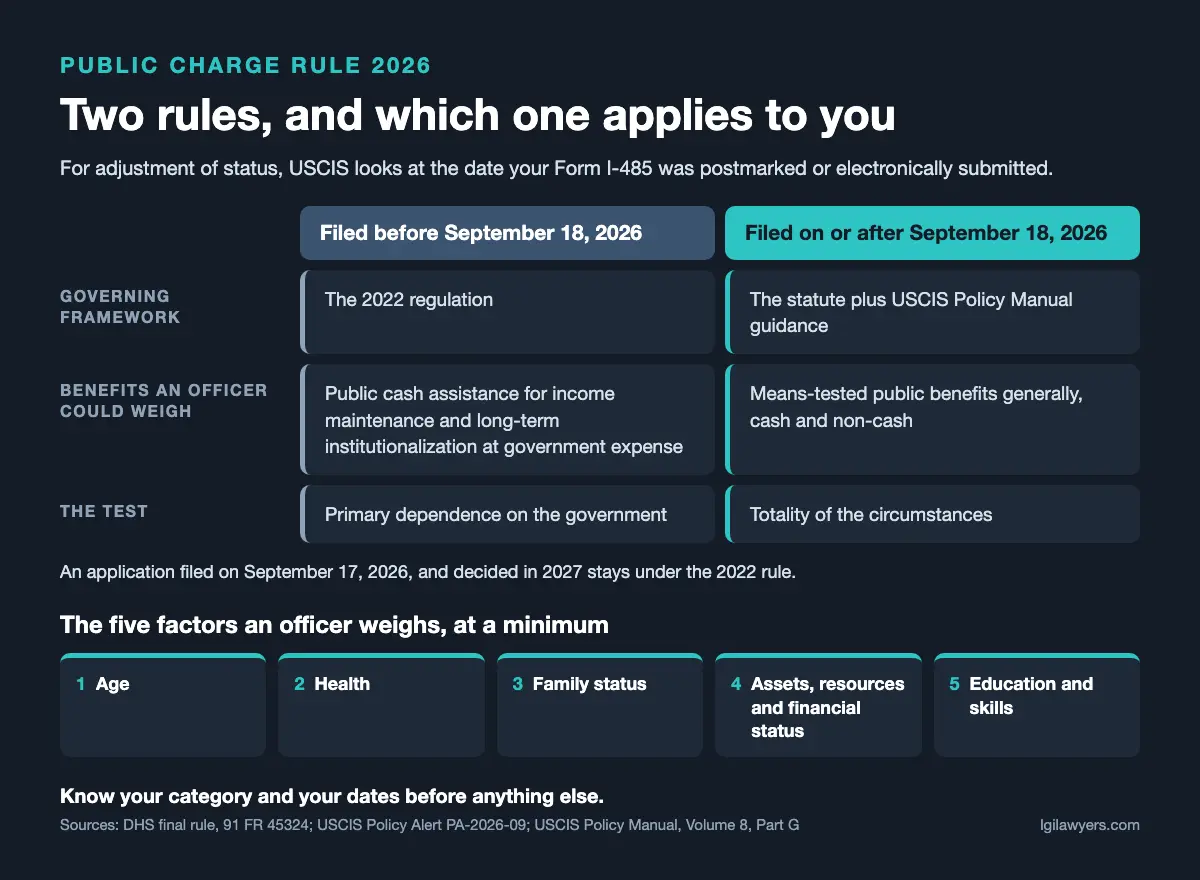
Two rules, and which one applies to you
Your filing date decides which framework applies. For adjustment of status, USCIS looks at the date your Form I-485 was postmarked or electronically submitted.
| Filed before September 18, 2026 | Filed on or after September 18, 2026 | |
|---|---|---|
| Governing framework | The 2022 regulation | The statute plus USCIS Policy Manual guidance |
| Benefits an officer could weigh | Public cash assistance for income maintenance and long-term institutionalization at government expense | Means-tested public benefits generally, cash and non-cash |
| The test | Primary dependence on the government | Totality of the circumstances |
The 2022 column covers applications filed from December 23, 2022. Older filings follow the 1999 Interim Field Guidance, an earlier set of agency instructions, according to PA-2026-09.
An application filed on September 17, 2026, and decided in 2027 stays under the 2022 rule.
For benefits received before September 18, 2026, USCIS says officers “will only consider public cash assistance for income maintenance and long-term institutionalization at government expense.” Under the 2022 rule, cash assistance meant Supplemental Security Income (SSI), cash from Temporary Assistance for Needy Families (TANF) and state or local cash programs.
Earlier cash benefits can still be weighed, even in a case filed today. USCIS does not consider earlier non-cash benefits, such as food assistance. Neither the rule nor the guidance says how much weight those earlier cash benefits carry.
USCIS also weighs applications and approvals for benefits made on or after September 18, 2026, but not earlier ones. USCIS guidance adds that an approval running past that date is weighed unless the person shows they disenrolled (formally left the program) or withdrew the application. That rule is not a reason to drop a benefit on your own, so ask an attorney first.
USCIS also lists 09/18/26 as the current edition of Form I-485 and warns that pages from another edition may be rejected.
If you received benefits in the past, write down which programs, for whom and on what dates. That list lets an attorney tell you which framework reaches each one.
Who the rule applies to, and who is exempt
The rule applies to most family-based and employment-based green card applicants, and to people seeking visas or admission. It does not apply to nonimmigrants who ask USCIS to extend their stay or change their status. Nonimmigrants are people in the United States on temporary visas.
USCIS’s guidance covers only Form I-485 cases, not visa applications or CBP inspections. Consular cases follow State Department guidance, which we cover in our page on State Department visa measures.
The 2026 rule did not change who is exempt. In DHS’s words, it “changes which public benefits are considered,” not “which aliens are exempt.” The exemptions come from statute, and USCIS lists them in Chapter 3 of Part G. They include:
- Refugees and asylees
- Self-petitioners under the Violence Against Women Act (VAWA), survivors of abuse who file on their own
- U nonimmigrants, a status for victims of certain crimes, and T nonimmigrants, a status for trafficking victims
- Special immigrant juveniles, a status for certain children who were abused, neglected or abandoned
- People applying for Temporary Protected Status (TPS)
- Afghan and Iraqi interpreters and nationals employed by or on behalf of the U.S. government
- Cuban Adjustment Act applicants, and registry applicants (registry is a green card path for long-time residents)
The full USCIS list is longer. Public charge also never applies to U.S. citizens, because the statute reaches only people seeking a visa, admission or adjustment. One caution applies: some exempt applicants who adjust through a relative’s employment-based petition stay exempt but must still file an affidavit of support.
If you are in an exempt category, public charge does not apply to that application. Confirm your category with an attorney before you rely on the exemption, because the answer depends on how you apply.
The five factors an officer weighs
What does an officer actually look at? The statute requires five factors, at a minimum:
- Age
- Health
- Family status, which includes the size of your household
- Assets, resources and financial status
- Education and skills
The officer “may also consider” an affidavit of support, which is separate from the five factors.
USCIS explains how each factor works in Chapter 5 of Part G. The financial factor looks at your household’s income, assets and liabilities, including debts. Income that comes from means-tested benefits “cannot be considered positively.” Health insurance that is not a public benefit can help show you can cover medical costs.
The officer weighs each factor together with the others. USCIS calls this the “totality of the circumstances.” No single factor decides the case. The one exception is a required affidavit of support that is not sufficient: that alone can make you inadmissible.
Under a totality test, the strength of your whole record matters more than any single item. Pay stubs, tax returns, proof of skills and medical coverage all go into that record.
Start gathering those documents now, well before an interview, so that gaps can be explained rather than discovered.
Benefits your children receive
USCIS gives a two-part answer.
First, USCIS does not treat a benefit your child receives as your own receipt. The Policy Manual says USCIS “does not attribute” benefits received by “relatives, including children” to the applicant. The same applies when you only applied on someone else’s behalf.
Second, the household’s finances still count. Suppose your child qualifies for a program because your income is below its limit. The officer may then weigh that low income under the financial factor. A household member’s benefits also matter if they are your source of support or if you are legally required to support that person.
Form I-485 does not ask about household members’ benefits, but your income and tax records still show the family’s finances.
Children who are themselves applying are not exempt because of their age. When a child is the applicant, the officer looks closely at the parents’ or guardians’ resources.
This narrow rule cuts both ways: household finances still matter, but a child’s coverage does not sink your case by itself. Families with U.S. citizen children facing other immigration problems can read our guide to benefits for U.S. citizen children.
If your children receive benefits, ask an attorney to review your household income before you file.
The affidavit of support (Form I-864)
Most family-based applicants need Form I-864, the Affidavit of Support. In it, a sponsor accepts a legally enforceable duty to support the immigrant financially.
USCIS says the sponsor generally must show income of at least 125 percent of the Federal Poverty Guidelines for the sponsor’s household size. A sponsor can be the petitioner or, when that income is not enough, a joint sponsor.
The affidavit has a special status in the analysis. A missing or insufficient affidavit, when one is required, is enough by itself for a public charge finding. A sufficient one is only “one factor in the totality of the circumstances,” according to the Policy Manual.
Some applicants do not need Form I-864. Examples include people who have earned, or can be credited with, 40 quarters of work under Social Security, and self-petitioning widows and widowers.
The current edition of the form also authorizes USCIS and the State Department to request the sponsor’s credit report. Our guide to the sponsor credit report on Form I-864 explains that change and the edition USCIS accepts.
Before filing, check that your sponsor’s income clears the threshold and that tax transcripts and proof of employment are complete.
Five situations, and how the analysis differs
Here is how the rules play out in five hypothetical cases. They are illustrations, not case results.
- A family that filed on September 10, 2026, while their children received nutrition benefits. The 2022 rule governs, so non-cash programs fall outside the analysis. The children’s benefits are not attributed to the parents in any event.
- The same family filing in October 2026. The newer framework governs. The children’s benefits are still not attributed to the parents, but the household’s income is weighed under the financial factor.
- An asylee adjusting status in November 2026 who used Medicaid in 2025. Asylees adjusting as asylees are exempt by statute. The change does not reach this case.
- An applicant filing in December 2026 who received a means-tested benefit in 2024. The benefit came before September 18, 2026. It counts only if it was cash assistance for income maintenance or long-term institutional care. In one USCIS example, an officer did not consider emergency Medicaid received in 2025.
- A U nonimmigrant adjusting status in 2027. U nonimmigrants are on the USCIS exemption list, so public charge does not apply. If the green card comes through a relative’s employment petition, the applicant stays exempt but must still file an affidavit of support.
Across all five, your category and your dates decide most of the outcome. Put both on paper before your first meeting with an attorney.
Open questions and litigation
A group of states is challenging the rule in federal court. On September 14, 2026, New York and other states filed State of New York v. U.S. Department of Homeland Security, No. 1:26-cv-07978, in the U.S. District Court for the Southern District of New York. The plaintiffs include Virginia, Maryland and the District of Columbia.
The complaint argues that the rule and the USCIS guidance violate the Administrative Procedure Act, the federal law on agency rulemaking. The states also argue the rule exceeds DHS’s authority and ask the court to vacate it.
A lawsuit does not suspend a rule by itself. As of this update, no court order has suspended the rule, so check for changes before you file.
Frequently asked questions
Will using Medicaid stop me from getting a green card?
Not by itself. In a USCIS adjustment case, USCIS does not consider Medicaid received before September 18, 2026, except for long-term institutional care. Medicaid received on or after that date can be weighed with the rest of your record, unless your category is exempt. For consular cases, the State Department applies its own guidance.
Is the public charge rule still just a proposal?
No. DHS proposed it in November 2025, finalized it on July 20, 2026, and it took effect on September 18, 2026. A lawsuit against it is pending in federal court in New York.
Do the benefits my U.S. citizen children receive count against me?
USCIS does not treat your child’s benefit as your own. An officer may still consider your income if your child qualified because that income is low. The officer may also review your legal duty to support your child.
Does a benefit I used before September 18, 2026 still matter?
It depends on the type of benefit. In adjustment cases, USCIS says officers will only consider earlier cash assistance for income maintenance and long-term institutional care. USCIS does not consider earlier non-cash benefits, such as food assistance.
Does public charge apply when I apply for citizenship or renew my green card?
The statute ties public charge to visa, admission and adjustment applications, not to naturalization or green card renewal. A permanent resident returning from a trip can, in limited cases, be treated as seeking admission.
I already used a benefit that might count. What should I do now?
Do not decide about your family’s health care or food based on a general article. Your category, filing date, the program and its dates all matter, and an attorney can review them before you change anything.
Planning your filing under the new framework
Know your category and your dates before anything else. If you are exempt, confirm it. If you are not, build the record the five factors reward, and make sure your sponsor’s affidavit is solid.
Benefits often cover a family’s health care or food, so these questions feel personal. Every case is different, and the right step depends on facts a general guide cannot see.
Attorneys Khalid Shekib and Daniela Lucena of Law Group International review adjustment filings for public charge issues for families across Virginia, Washington, D.C., and Maryland. Reviewing benefits before filing helps avoid surprises at the interview.
Ready to prepare your case with an experienced immigration team?
Schedule a consultationKhalid Shekib & Daniela Lucena · Law Group International
Offices in Alexandria, VAThis article provides general information and is not legal advice. Reading it does not create an attorney-client relationship with Law Group International. Immigration law changes often and every case is different, so speak with an immigration attorney about your own situation.
Sources
- U.S. Department of Homeland Security, Public Charge Ground of Inadmissibility, final rule, 91 FR 45324 (July 20, 2026), document 2026-14539: https://www.federalregister.gov/documents/2026/07/20/2026-14539/public-charge-ground-of-inadmissibility
- U.S. Department of Homeland Security, Public Charge Ground of Inadmissibility, proposed rule, 90 FR 52168 (November 19, 2025), document 2025-20278: https://www.federalregister.gov/documents/2025/11/19/2025-20278/public-charge-ground-of-inadmissibility
- USCIS, Policy Alert PA-2026-09, Public Charge Ground of Inadmissibility (August 18, 2026): https://www.uscis.gov/sites/default/files/document/policy-manual-updates/20260818-PublicChargeFinalRule.pdf
- USCIS Policy Manual, Volume 8, Part G, Chapter 2 (Key Concepts): https://www.uscis.gov/policy-manual/volume-8-part-g-chapter-2
- USCIS Policy Manual, Volume 8, Part G, Chapter 3 (Applicability): https://www.uscis.gov/policy-manual/volume-8-part-g-chapter-3
- USCIS Policy Manual, Volume 8, Part G, Chapter 5 (Statutory Minimum Factors): https://www.uscis.gov/policy-manual/volume-8-part-g-chapter-5
- USCIS Policy Manual, Volume 8, Part G, Chapter 6 (Affidavit of Support): https://www.uscis.gov/policy-manual/volume-8-part-g-chapter-6
- USCIS Policy Manual, Volume 8, Part G, Chapter 7 (Means-Tested Public Benefits): https://www.uscis.gov/policy-manual/volume-8-part-g-chapter-7
- USCIS, Form I-485: https://www.uscis.gov/i-485
- USCIS, Form I-864: https://www.uscis.gov/i-864
- INA section 212(a)(4), 8 U.S.C. 1182(a)(4), Legal Information Institute: https://www.law.cornell.edu/uscode/text/8/1182
- State of New York et al. v. U.S. Department of Homeland Security et al., No. 1:26-cv-07978 (S.D.N.Y.), complaint filed September 14, 2026: https://ag.ny.gov/sites/default/files/court-filings/new-york-et-al-v-u.s-department-of-homeland-security-et-al-complaint-2026.pdf
Last updated: November 2026