


Third-country removals: what the Supreme Court’s order means
A third-country removal happens when the government deports a person to a country that their removal order does not name. On September 29, 2026, the Supreme Court issued a short order in the main case on third-country removals, Department of Homeland Security v. D.V.D.
The order is temporary. It pauses a lower court judgment that required notice and a chance to raise fear before these removals. The Court has not said whether the government’s policy is lawful. It will hear arguments on December 9, 2026, and decide the case after that.
If you or a relative has a final removal order, this is hard news to read. Here is what the order says, what it leaves open, and what you can prepare.
What third-country removals are under federal law
Federal law lists the countries to which the government may deport a person. The list is in section 1231(b) of Title 8 of the U.S. Code.
For most people, that section starts with a country the person designates. It then names the country of citizenship and several others, such as the country of birth. The last option on the list is another country whose government agrees to accept the person.
Whether the government must follow that list in a set order is part of the dispute before the Court.
The Department of Homeland Security (DHS) uses “third country” for any country other than the one designated in the removal order. Its policy sits in two memos, dated March 30, 2025 and July 9, 2025. Both appear in the appendix the government filed with the Supreme Court.
If you are not sure which country your order names, start with what a final order of deportation means and read your own order again.
What the lower courts required before a third-country removal
On February 25, 2026, Judge Brian E. Murphy of the federal district court in Massachusetts entered a final judgment in a class action. The class covers people with final removal orders whom DHS deports to a country their order did not designate.
The judgment declared that class members have a right to “meaningful notice” before removal to any third country. It also declared their right to a “meaningful opportunity” to raise a claim about that specific country. The judge set aside the DHS policy as unlawful.
On September 18, 2026, the U.S. Court of Appeals for the First Circuit reviewed that judgment in case No. 26-1212. It kept the notice and opportunity requirements. It removed two declarations that required DHS to try the designated country or the country of citizenship first.
The judgment had been on hold since March 16, 2026. The First Circuit lifted that hold on September 23, 2026.
What the Supreme Court did on September 29
The order is one paragraph long, gives no reasons, and does four things.
- It pauses the district court’s ruling. In the Court’s words, the “February 25, 2026 order and judgment” of the Massachusetts district court “are stayed.”
- It takes the case. The Court treated the government’s request as a petition for certiorari, which is a request for the Court to review a case, and granted it. The case number is 26-426.
- It sets the questions. Two concern whether the district court had the power to hear the case and grant relief to a whole class. One asks whether the DHS guidance is unlawful under the statute, the Due Process Clause, or the rules that carry out the Convention Against Torture.
- It sets an end point. The pause lasts until the Court sends down its own judgment.
The order notes that Justice Sotomayor, Justice Kagan, and Justice Jackson would have denied the pause.
Because two questions concern court power, the Court could resolve the case without ruling on due process. The docket and the December argument calendar both show argument on Wednesday, December 9, 2026.
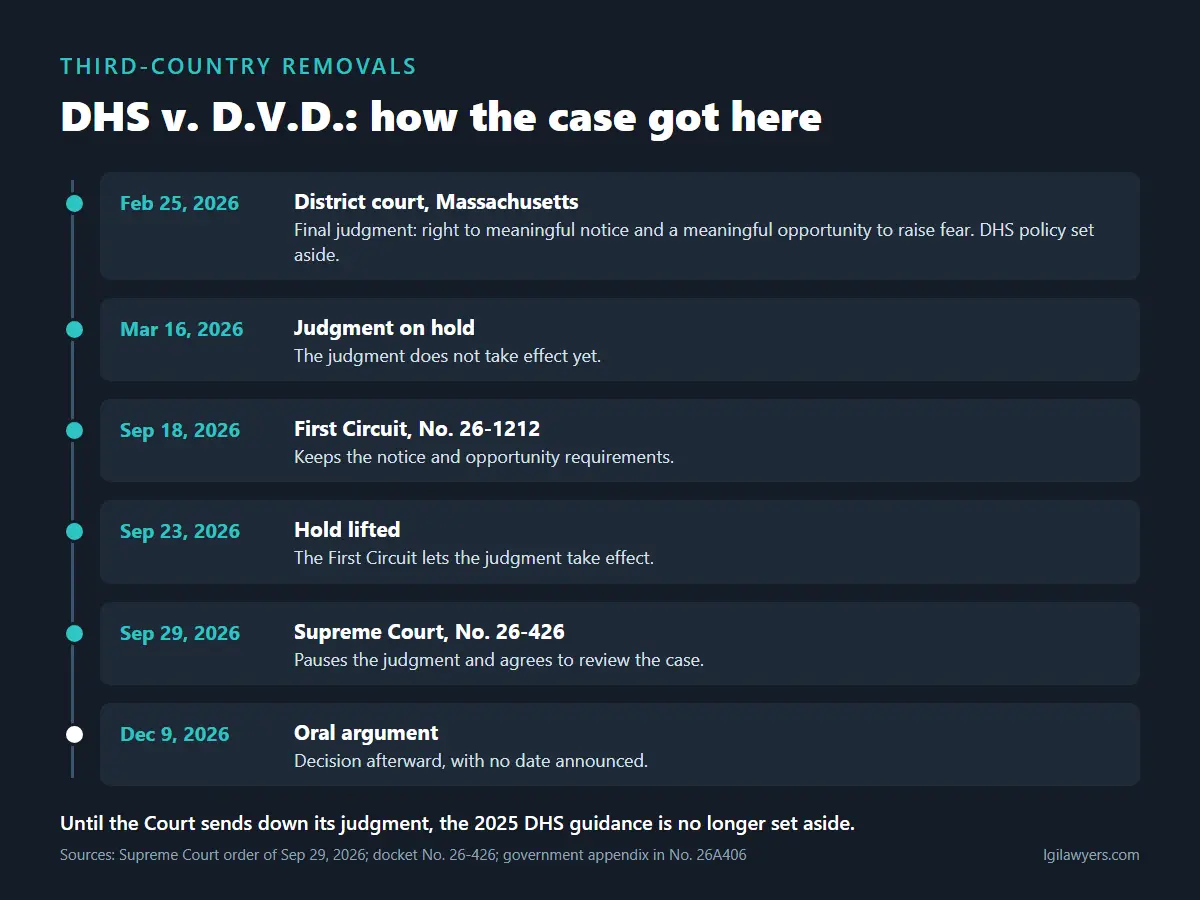
What applies to third-country removals until the Court rules
What does a pause mean in practice? With the judgment on hold, the DHS guidance is no longer set aside. That is the practical effect of the order, not a statement by the Court that the removals are lawful.
The two memos describe this process for people with final orders:
- Diplomatic assurances. If the country of removal has assured the United States that people removed there will not be persecuted or tortured, and the State Department finds those assurances credible, the memos allow removal “without the need for further procedures.”
- Written notice in other cases. An officer serves a notice that names the country and reads it in a language the person understands.
- No question about fear. Officers “will not affirmatively ask” whether the person is afraid of removal to that country. The person has to say it.
- A short wait. Immigration and Customs Enforcement (ICE) will “generally wait at least 24 hours” after serving the notice. In exigent circumstances, the July 2025 memo allows removal six or more hours after the notice, if the person has a reasonable means and opportunity to speak with an attorney and the DHS General Counsel approves. If the person does not state a fear within 24 hours, the memo allows removal to the country on the notice.
- Screening if fear is stated. U.S. Citizenship and Immigration Services (USCIS) decides whether it is “more likely than not” that the person would be persecuted on a protected ground or tortured in that country. If not, the memos say the person will be removed. If so, the matter goes to an immigration court, or ICE may choose another country.
These memos date from 2025. This article describes what they say in writing, not how they are applied in a specific case. For the wider context, see our overview of immigration policy in 2026.
Who is most exposed to a third-country removal
The lawsuit and the DHS guidance both concern people with final removal orders. The March 2025 memo says it does not address expedited removal. That is a separate process under section 235(b)(1) of the Immigration and Nationality Act, in which an immigration officer can order certain people who have not been admitted or paroled removed without further hearing or review, unless they say they fear persecution or want to apply for asylum.
Withholding of removal bars deportation to a country where your life or freedom would be threatened because of race, religion, nationality, membership in a particular social group, or political opinion. Protection under the Convention Against Torture (CAT) applies when it is more likely than not that you would be tortured in a country, and it takes the form of withholding or, in some cases, deferral of removal. Both are granted for a specific country.
The withholding regulation says nothing in it or in the deferral regulation prevents removal to a third country other than the one to which removal has been withheld or deferred. A person granted deferral must be told that they may be removed at any time to another country where they are not likely to be tortured. So a grant of withholding or CAT protection does not, by itself, rule out a different country.
If you still have an open proceeding where you can raise fear, the memo says DHS follows its existing procedures. Our guide to appealing a deportation order explains those stages.
What you can do now if you have a final order
Preparation is the part you control, whatever the Court decides.
- Know which countries you fear, and talk to an attorney about them. Under the guidance, officers will not ask about fear, so a person who fears removal to the country on the notice has to say so. An attorney can explain how and when to raise that fear in your case.
- Keep your attorney reachable. Carry the name and number, and give them to a relative.
- Keep copies of your order and any grant of protection. They show which countries are involved.
- Keep track of your ICE check-ins. If you were released under an order of supervision, it can require you to report to an officer periodically, and the regulations say a person who violates the conditions of release may be returned to custody. If you are worried about an appointment, speak with an attorney before the date.
- Know how to find a relative who is detained. According to press reports, people with final removal orders may no longer appear in ICE’s online locator. Our guide explains what to do when a relative is not listed in the ICE detainee locator.
Every case is different, and the right step depends on your order, your history, and the country involved. If your fear relates to a past or possible asylum claim, review the asylum process in the United States as background.
We know how overwhelming this feels. You don't have to face this alone.
Navigating the immigration process can be one of the most stressful experiences a family goes through. Our attorneys work with individuals and families who are facing these situations, and we can help you understand your options.
Khalid Shekib & Daniela Lucena · Law Group International · Alexandria, VA
Frequently asked questions
Can I be deported to a country I have never lived in?
The statute’s last option is any country whose government agrees to accept you. How DHS may use that option is part of the case. For removals to specific countries, see our article on deportations to Venezuela and El Salvador.
Does this affect me if I do not have a final order?
The lawsuit and the DHS guidance concern people who already have a final removal order. For people with an open proceeding where they can raise fear, the memo says DHS follows its existing procedures. The memo does not describe those procedures, so an attorney can tell you how this applies to you.
Will I get notice before removal?
It depends. Where the State Department accepts a country’s assurances, the memo allows removal with no further procedures. In other cases, an officer serves a written notice naming the country, and ICE generally waits at least 24 hours.
What happens after December 9?
The Court hears argument that day and decides later, with no date announced. The pause stays in place until the Court sends down its judgment.
Should I file anything now?
Federal law allows a motion to reopen a removal case. As a general rule, a person may file one such motion within 90 days of the final order. The law sets exceptions, for example for asylum or withholding requests based on changed country conditions, with evidence that could not have been presented before. Whether any of this fits you depends on your order, your history, and the country you fear, so review your file with an immigration attorney before filing anything.
The order is a pause, and the decision is still ahead
The Supreme Court has paused the notice requirements without deciding whether the government’s process is lawful. That answer comes after the December 9 argument. Until then, know which country your order names and talk to an attorney about any country you fear.
Law Group International follows this case because its outcome reaches clients who already hold a final order. Attorneys Khalid Shekib and Daniela Lucena represent clients in Virginia, Washington D.C., and Maryland, in English and Spanish.
Ready to prepare your case with an experienced immigration team?
Schedule a consultationKhalid Shekib & Daniela Lucena · Law Group International
Offices in Alexandria, VAThis article provides general information and is not legal advice. Reading it does not create an attorney-client relationship with Law Group International. Immigration law changes often and every case is different, so speak with an immigration attorney about your own situation.
Sources
- Supreme Court of the United States, order of September 29, 2026, No. 26-426 (26A406)
- Supreme Court of the United States, docket No. 26-426
- Supreme Court of the United States, argument calendar for the session beginning November 30, 2026
- Appendix to the government’s application in No. 26A406: district court judgment, DHS and ICE memos, First Circuit opinion
- 8 U.S.C. 1231, detention and removal of aliens ordered removed
- 8 CFR 1208.16, withholding of removal
- 8 CFR 1208.17, deferral of removal under the Convention Against Torture
- 8 U.S.C. 1225, inspection by immigration officers and expedited removal
- 8 U.S.C. 1229a, removal proceedings (motions to reopen)
- 8 CFR 1003.23, reopening before the immigration court
- 8 CFR 241.4 and 241.5, release and orders of supervision
Last updated: October 2026.