

Picture someone who missed an immigration hearing because they were in the hospital that morning. Weeks later, they learn that the judge ordered them removed. Their first question is simple: can the case be reopened?
Sometimes it can. A motion to reopen immigration court proceedings asks the judge, or the Board of Immigration Appeals (BIA), to look again at a closed case. News like that can land like a locked door, yet the door is not always locked.
Two points come first. The general deadline is short: 90 days from the final order. And filing the motion usually does not stop a deportation. The main exception is an order the judge issued in absentia, at a hearing you did not attend.
What a motion to reopen is (and how it differs from an appeal and a motion to reconsider)
A motion to reopen asks to restart a decided case because of facts the judge never saw. The law requires it to state the new facts and back them with affidavits, which are sworn written statements, or other evidence (8 U.S.C. §1229a(c)(7)).
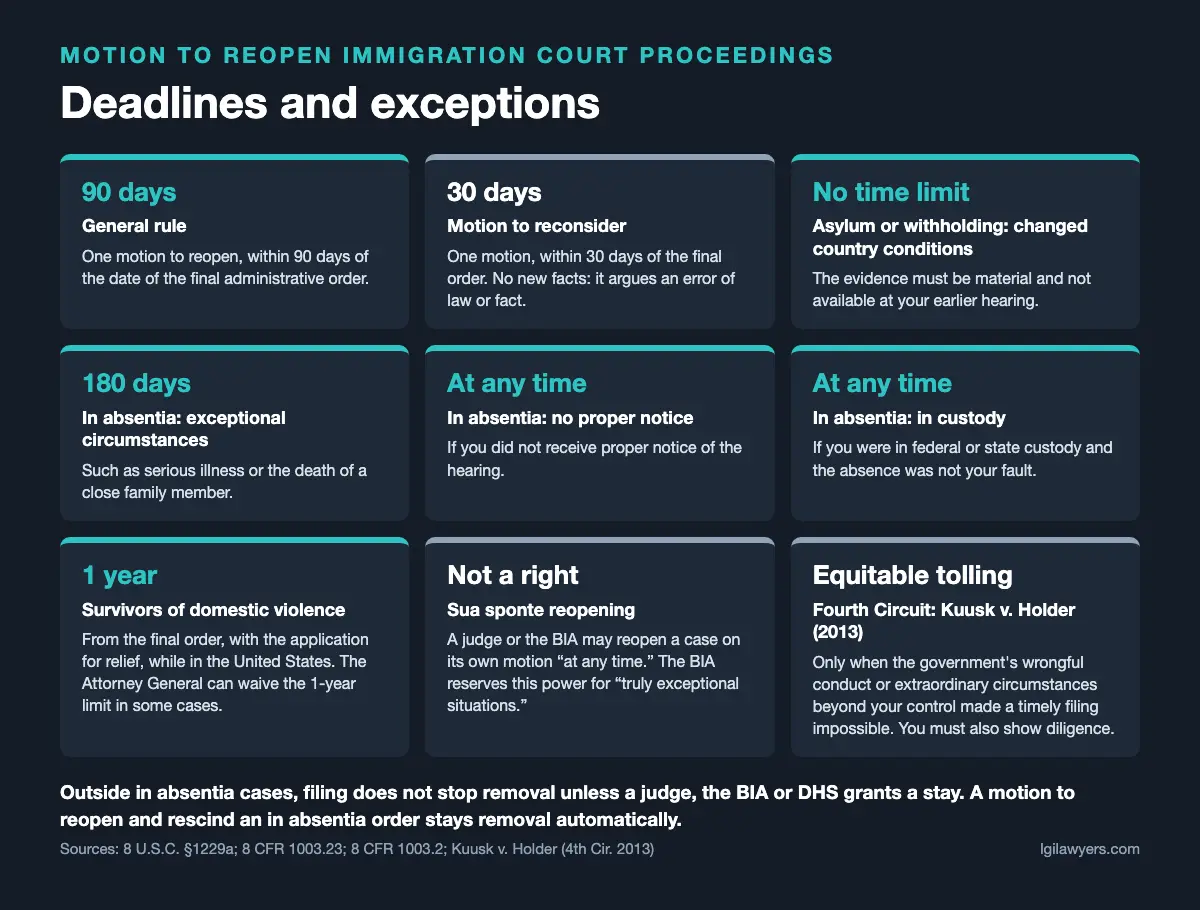
A motion to reconsider brings no new facts. It argues that the judge or the BIA made an error of law or fact. You can file one motion to reconsider, within 30 days of the final order (8 U.S.C. §1229a(c)(6)).
An appeal asks the BIA, a higher body, to review the judge’s decision on the existing record. Appeals have their own short deadline, so ask an attorney about that option right away. Write down the date on your order today.
The general deadline: one motion, 90 days
Under the general rule, you may file one motion to reopen, within 90 days of the date of the final administrative order (8 U.S.C. §1229a(c)(7)(A) and (C)(i)). The regulations of the Executive Office for Immigration Review (EOIR), the Justice Department office that runs the immigration courts, repeat these limits (8 CFR 1003.23(b)(1)).
The “final administrative order” is the judge’s order, if no one appealed, or the BIA’s decision on appeal. Our page on the final order of removal explains when an order becomes final.
The number limit matters as much as the date, because a rushed filing can use up your only chance. Equitable tolling is a doctrine that pauses a limit for fairness reasons. In August 2026, the BIA held in Matter of M-M-L-J- that it does not apply to the one-motion limit. The BIA applies that rule in circuits whose federal appeals court has not decided the question. The decision does not mention the Fourth Circuit, which covers Virginia and Maryland.
The 90-day deadline does have exceptions. The EOIR Policy Manual summarizes the rule in its section on motions to reopen.
Exceptions to the deadline
Some motions can be filed after 90 days.
Asylum based on changed country conditions
There is no time limit for a motion to apply for asylum or withholding of removal. Withholding is a protection that bars return to a country of persecution. The motion must rest on changed conditions in your home country. The evidence must also be material and not available at your earlier hearing (8 U.S.C. §1229a(c)(7)(C)(ii); 8 CFR 1003.23(b)(4)(i)).
Orders issued in absentia
If the judge ordered you removed because you missed a hearing, special deadlines apply (8 U.S.C. §1229a(b)(5)(C)):
- 180 days, if you missed the hearing because of exceptional circumstances, such as serious illness or the death of a close family member.
- At any time, if you did not receive proper notice of the hearing.
- At any time, if you were in federal or state custody and the absence was not your fault.
Our guide to in absentia orders explains how notice is proven.
Survivors of domestic violence
Certain survivors of battery or extreme cruelty can file outside the general limits. The motion must come within 1 year of the final order, with the application for relief, while the person is in the United States. The Attorney General can waive the 1-year limit in some cases (8 U.S.C. §1229a(c)(7)(C)(iv)).
The same provision says this motion stays removal while pending. That applies only if it shows the person is a “qualified alien” under federal benefits law, so ask an attorney.
Reopening on the judge’s or the Board’s own motion
The regulations allow an immigration judge to reopen a case on the judge’s own motion “at any time.” The BIA has the same power over its own decisions (8 CFR 1003.23(b)(1); 8 CFR 1003.2(a)). Lawyers call this sua sponte reopening.
It is not a right you can claim. In a June 12, 2026 decision, Matter of Herrera-Nunez, the BIA wrote that “sua sponte” “does not refer to a right of a party to seek reopening.” The BIA reserves this power for “truly exceptional situations.”
When a lawyer’s mistake caused the delay
The Fourth Circuit held in Kuusk v. Holder (2013) that the 90-day deadline can be equitably tolled. That applies only when the government’s wrongful conduct prevented a timely filing, or when extraordinary circumstances beyond your control made it impossible.
Kuusk did not involve a lawyer’s errors, so it does not say whether they meet that standard. The person must also show diligence, a reasonable effort to pursue the case despite the obstacles (Williams v. Garland, 2022). If you suspect a past attorney failed you, act as soon as you find out.
What the motion must include
A motion to reopen must explain the new facts you will prove at a new hearing, with affidavits and other evidence. If you are asking for a form of relief, you must attach the completed application and all its supporting documents (8 CFR 1003.23(b)(3)).
The evidence must also be “material,” meaning it could change the outcome, and unavailable at the earlier hearing.
A strong filing usually includes:
- A sworn declaration from you, explaining what changed and when you learned it.
- The completed application for relief, such as Form I-485 for a green card.
- Supporting documents, such as an approval notice, country reports, medical records or proof of a missed notice.
- A statement about other cases, saying whether the order is the subject of any court case or pending criminal proceeding.
The motion must be written, signed and in English, or come with a certified translation (8 CFR 1003.23(b)(1)(i)).
Common grounds for a motion to reopen immigration court proceedings
Most motions rest on one of four grounds.
A family petition that opens a path to a green card
A spouse’s Form I-130, the family petition a U.S. citizen or resident files for a relative, can support a motion to reopen. The goal is to apply for adjustment of status, the process of getting a green card without leaving the country. In Matter of Velarde-Pacheco (2002), the BIA allowed reopening for a marriage entered into during proceedings, even with the petition pending, when five conditions are met:
- The motion is filed on time.
- It is not barred by the one-motion limit.
- No procedural bar applies.
- There is clear and convincing evidence that the marriage is likely genuine.
- The government does not oppose it, or opposes it only on a narrow ground.
Ask an attorney whether later decisions change how these conditions apply.
Timing is the catch. In February 2026, the BIA held in Matter of Yadav that a marriage to a U.S. citizen after a removal order is not an exceptional situation for sua sponte reopening.
Changed conditions in your home country
New violence, a change of government or a new pattern of persecution can support a motion for asylum or withholding.
New eligibility for relief
The regulation limits motions based on discretionary relief, a benefit the judge may grant or deny. If the judge already explained your right to apply and gave you the chance, the motion will fail. The exception is relief based on circumstances that arose after the hearing. Cancellation of removal, which lets certain long-time residents stay, has extra limits on reopening (8 CFR 1003.23(b)(3)).
Mistakes by your prior attorney
Ineffective assistance of counsel means a lawyer’s errors were serious enough to make the hearing unfair. The BIA requires these motions to follow Matter of Lozada. You need a detailed affidavit, proof the prior lawyer was told and could respond, and a statement about a bar complaint, a grievance to the body that disciplines lawyers. Since July 2026, the BIA requires a copy and proof of filing, or an explanation of why none was filed.
Does filing a motion to reopen stop deportation?
No, in most cases. Outside in absentia cases, filing does not stop removal unless a judge, the BIA or the Department of Homeland Security (DHS) grants a stay (8 CFR 1003.23(b)(1)(v)). A stay is an order that pauses the deportation.
In absentia cases, the rules work differently. A motion to reopen and rescind an in absentia order automatically stays removal while the judge decides it (8 U.S.C. §1229a(b)(5)(C)). The domestic violence motion described above has its own limited stay.
For other motions, the stay is a separate request. In a second June 12, 2026 decision in the same case, Matter of Herrera-Nunez, the BIA set a general policy that a person should ask DHS first. The Board expects proof of that request, or an explanation of why it was not made in time. It recognized that an emergency, such as imminent removal from detention, may leave no time.
Leaving the country has consequences too. Under EOIR’s regulations, any departure after you file, including a deportation, counts as withdrawing the motion (8 CFR 1003.23(b)(1)). The Fourth Circuit has struck down a related BIA rule (see the FAQ), so ask an attorney how these rules apply to you. If removal is close, file the stay request with the motion.
Where to file: immigration judge or BIA, and the filing fee
The motion generally goes to the body that issued the last decision: the immigration court, if no one appealed, or the BIA, if it decided an appeal. Our overview of the stages of an immigration court case shows where each decision happens.
Since October 1, 2026, the fees set in 8 CFR 1103.7(b)(2) combine an EOIR fee with a fee created by the 2025 budget law known as H.R. 1:
- $1,095 for a motion to reopen an immigration judge’s decision ($145 plus $950).
- $1,060 for a motion to reopen a BIA decision ($110 plus $950).
- $950 for a motion based only on an application for relief that has no fee.
You pay only through the EOIR Payment Portal, and fees are generally non-refundable. Some motions carry no fee, including an in absentia motion based on lack of notice or custody, and a motion that only asks for a stay (8 CFR 1003.24(b)(2)). An in absentia motion based on exceptional circumstances does pay. EOIR updates the H.R. 1 amounts each year, so check its fee page before filing.
EOIR’s rules let a judge or the BIA waive the fee for a motion when the person shows they cannot pay. The BIA uses Form EOIR-26A (8 CFR 1003.8(a)(3)); a judge asks for a sworn or unsworn declaration (8 CFR 1003.24(d)). H.R. 1 bars waivers of several other fees, but its motion fee section says nothing about waivers. The rules do not say whether a waiver also reaches the $950 H.R. 1 portion. The BIA also presumes that a non-detained person with a private attorney can pay, so ask an attorney before counting on a waiver.
Frequently asked questions
Can I reopen my case if I was already deported?
Possibly, but the rules conflict. EOIR’s regulations say a motion cannot be filed by or for a person after that person leaves the United States. In William v. Gonzales (2007), the Fourth Circuit held that the BIA’s version of that rule conflicts with the statute and is invalid. The case concerned the BIA’s version, not the judge’s, so ask an attorney how it applies.
How long does a decision on my motion take?
EOIR’s motion rules set no deadline for a decision. If removal is a risk while you wait, ask about a stay right away.
Can I file a second motion to reopen?
Generally, no. The law allows one motion to reopen, with narrow exceptions. EOIR’s rules exempt asylum motions based on changed country conditions from the number limit, and the statute allows one extra motion for certain domestic violence survivors.
What if my previous lawyer did not file something on time?
You may have a claim for ineffective assistance of counsel under the Lozada requirements described above. The BIA does not accept these claims when the person you hired was not an attorney and did not claim to be one.
Can I reopen my case with an approved I-130?
Possibly, if the motion is filed on time and meets the Velarde-Pacheco conditions. After the 90 days, the BIA held in Yadav that a marriage after the removal order is not an exceptional situation. Have an attorney check your dates.
Can USCIS reopen my immigration court case?
No. USCIS uses Form I-290B for motions on its own decisions. Its page says not to use that form for decisions of an immigration judge or the BIA. To reopen a court case, you file with EOIR.
Reopening a case is time-sensitive
Three facts usually decide which deadline applies: when the order became final, who issued it and when you learned the new facts. Gather the order and every notice you received.
Clients in Virginia, Washington, D.C., and Maryland can bring those papers to attorneys Khalid Shekib and Daniela Lucena at Law Group International. They can review which deadline may apply and what a motion would need to include. The order has a date on it, and so does every option that follows.
Ready to prepare your case with an experienced immigration team?
Schedule a consultationKhalid Shekib & Daniela Lucena · Law Group International
Offices in Alexandria, VAThis article provides general information and is not legal advice. Reading it does not create an attorney-client relationship with Law Group International. Immigration law changes often and every case is different, so speak with an immigration attorney about your own situation.
Sources
- 8 U.S.C. §1229a, Removal proceedings (Cornell LII)
- 8 CFR §1003.23, Reopening or reconsideration before the Immigration Court (Cornell LII)
- 8 CFR §1003.2, Reopening or reconsideration before the BIA (Cornell LII)
- 8 CFR §1003.8, Fees before the Board (Cornell LII)
- 8 CFR §1003.24, Fees before the Immigration Judges (Cornell LII)
- 8 CFR §1103.7, Fees (Cornell LII)
- EOIR, Types of Appeals, Motions, and Required Fees
- EOIR Policy Manual, 4.7 Motions to Reopen
- Matter of Velarde-Pacheco, 23 I&N Dec. 253 (BIA 2002)
- Matter of Yadav, 29 I&N Dec. 438 (BIA 2026)
- Matter of Herrera-Nunez, 29 I&N Dec. 691 (BIA 2026)
- Matter of Herrera-Nunez, 29 I&N Dec. 695 (BIA 2026)
- Matter of L-R-M-C- & V-A-M-M-, 29 I&N Dec. 757 (BIA 2026)
- Matter of M-M-L-J-, 29 I&N Dec. 843 (BIA 2026)
- Matter of Z-R-C-N-, 29 I&N Dec. 523 (BIA 2026)
- Kuusk v. Holder, No. 12-2367 (4th Cir. 2013)
- Williams v. Garland, No. 20-1854 (4th Cir. 2022)
- William v. Gonzales, No. 06-1284 (4th Cir. 2007)
- Public Law 119-21 (H.R. 1), sec. 100013(g), motion fee (Congress.gov)
- USCIS, Form I-290B, Notice of Appeal or Motion
Last updated: November 2026