

To find out whether you have an ICE check-in appointment, look first at the papers you received when you left custody. They often list the date, time and office. If you were released with border paperwork and no date appears, ICE’s official portal lets you book one.
ICE is U.S. Immigration and Customs Enforcement, the agency within the Department of Homeland Security (DHS) that handles immigration detention and removal. A check-in is the periodic visit to ICE that many released people must make to stay free while their case moves forward. Missing it has consequences. Walking in without talking to a lawyer first carries its own risks.
If you are on an order of supervision or enrolled in ISAP, an ICE supervision program, read the conditions on your own paperwork first: ICE’s check-in page does not address those cases.
How to find out if you have an ICE check-in appointment
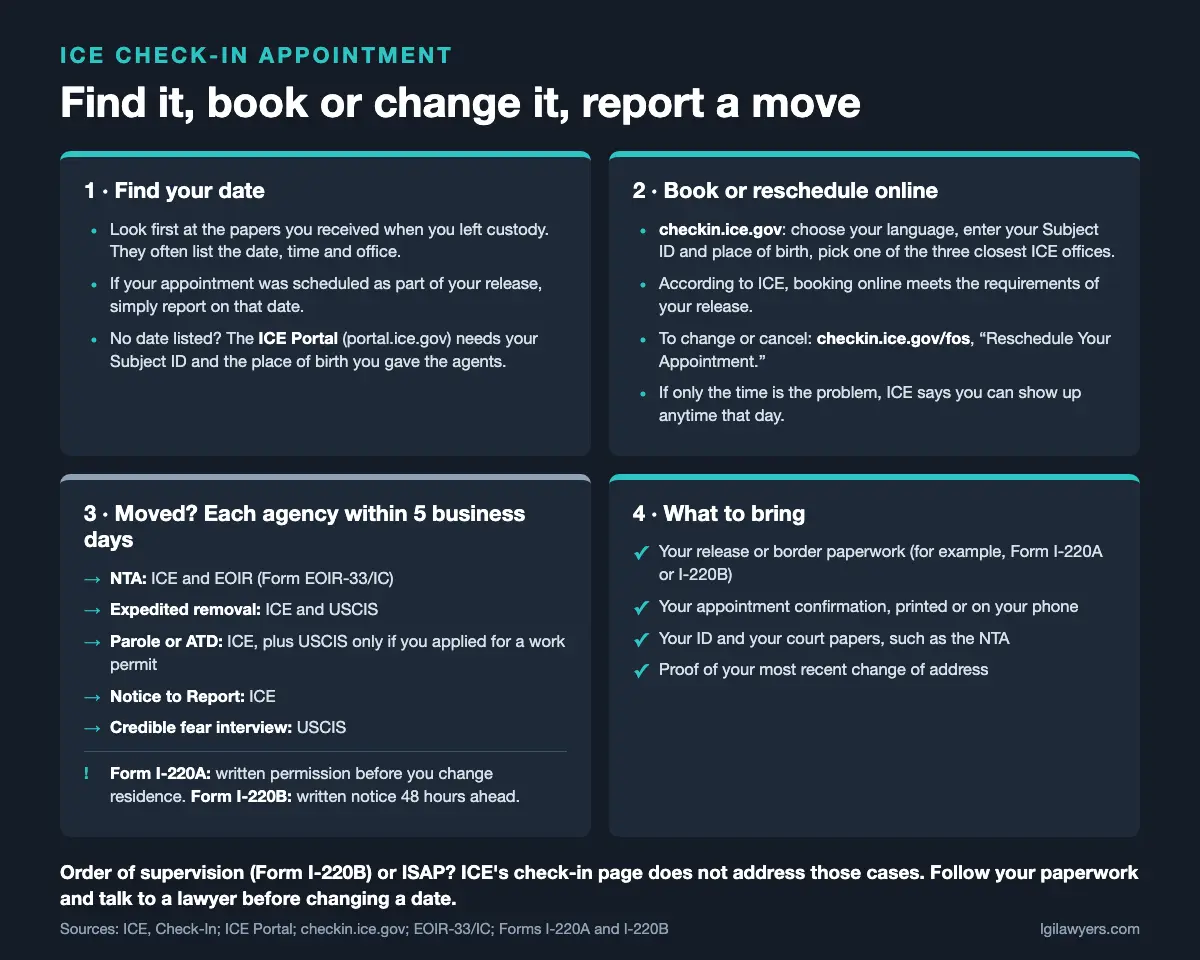
ICE’s check-in page cautions that release paperwork may not include a reporting date, location and time. If your appointment was scheduled as part of your release, ICE says you do not need to make a new one online. Simply report on that date.
If no date is listed, the ICE Portal is open to anyone placed in removal proceedings. It lets you update your address, see your court hearing details and schedule or change a check-in. You will need your Subject ID, the identification number on your border paperwork, and the place of birth you gave the agents.
A check-in is not a court hearing. Immigration courts belong to the Executive Office for Immigration Review (EOIR), part of the Department of Justice. You must keep both appointments. Our guide on what happens if you miss an immigration court hearing covers the court side.
How to schedule or reschedule an ICE check-in online
ICE handles booking at checkin.ice.gov, with no call or office visit needed:
- Choose your preferred language.
- Enter the Subject ID and place of birth from your paperwork, and complete the “I’m not a robot” check.
- Enter your address and pick one of the three closest ICE offices.
- Confirm the appointment and print, email or text yourself the details.
According to ICE, booking online meets the requirements of your release. That holds even if the next open date falls after the deadline on your paperwork, or you now live somewhere else.
To change or cancel, ICE points you to checkin.ice.gov/fos and its “Reschedule Your Appointment” option. ICE describes that step for one situation: your paperwork sets a date and you cannot appear at an ICE office that day. If only the time is the problem, ICE says you can show up anytime that day. Already have a date but moved? ICE says to report that day to an ICE office near you.
ICE builds these steps around the paperwork you received at the border. The page does not mention orders of supervision (Form I-220B) or ISAP, or say whether the online system works in those cases. If either applies to you, follow your paperwork and talk to a lawyer before changing a date.
Moving? Notify each agency within 5 business days
ICE’s check-in page says you must update your address with each agency that applies to you within 5 business days of moving. Which agencies apply depends on your paperwork:
- Notice to Appear (NTA), the document that starts removal proceedings: ICE and EOIR.
- Expedited removal, without a hearing before a judge: ICE and U.S. Citizenship and Immigration Services (USCIS).
- Parole, permission to remain in the country temporarily, or an Alternatives to Detention (ATD) program: ICE, plus USCIS only if you applied for a work permit.
- Notice to Report, an instruction to report to ICE: ICE.
- Credible fear interview, where USCIS assesses your fear of returning home: USCIS.
For ICE, call the DRIL (Detention, Removals and Information Line) at 1-888-351-4024, Monday through Friday, 8 a.m. to 8 p.m. Eastern, or use the ICE Portal. For the court, EOIR requires Form EOIR-33/IC within five working days, online through Respondent Access, in person or by mail. For USCIS, use its change of address tool or Form AR-11; USCIS allows 10 days, so 5 business days covers both.
Some release papers require permission or notice before you move. Form I-220A requires written permission from the officer before you change residence. Form I-220B requires written notice 48 hours ahead. ICE’s page does not explain how these conditions fit with the 5-business-day rule. If either form is yours, talk to a lawyer before moving.
What happens at an ICE check-in
ICE does not publish a script for check-ins, but its release forms show what the officer is checking. Many people sign Form I-220A, the Order of Release on Recognizance, when released. Its conditions include:
- reporting for any hearing or interview as directed by ICE or EOIR;
- not violating any local, state or federal law;
- helping ICE obtain any necessary travel documents;
- surrendering for removal if ordered.
People with a final order that ICE has not carried out within the period set by law may be placed under Form I-220B, the Order of Supervision. Its conditions go further. One is to appear in person “upon each and every request of the agency, for identification and for deportation or removal.” Others include giving information under oath about one’s circumstances and activities, and getting approval before certain travel.
Both forms include a personal report record with the date, the officer and space for comments or changes. In other words, each visit is logged, and your conditions can change at it.
Both forms also allow ICE to require an Alternatives to Detention program, with electronic monitoring and a possible curfew. Our guide to ICE alternatives to detention explains how those programs work.
At the appointment you can ask for your identification, passport or other held paperwork back; ICE will review the request. Follow any instructions you receive there.
There is also a risk of detention. Under 8 CFR 236.1(c)(9), the release of a person who was arrested and taken into custody may be revoked at any time. For people released under an order of supervision, 8 CFR 241.4(l) allows revocation for reasons that include violating a condition or when it is appropriate to enforce a removal order. That rule also says the person will be told the reasons and given an initial informal interview promptly after the return to custody. Which rule applies to you depends on your case; ask a lawyer.
It makes sense to feel uneasy before a check-in, especially given recent news. On November 9, 2026, FOX 5 DC reported that ICE detained a University of Maryland student and her mother during a check-in in Baltimore.
Update, November 18, 2026: FOX 5 DC reported that the student and her mother were released from ICE custody and were heading home from Louisiana.
A single case says nothing about how often this happens, but it shows why every check-in deserves preparation. If you have a removal order, or are not sure whether you do, speak with a lawyer before you report.
We know how overwhelming this feels. You don't have to face this alone.
Navigating the immigration process can be one of the most stressful experiences a family goes through. Our attorneys work with individuals and families who are facing these situations, and we can help you understand your options.
Khalid Shekib & Daniela Lucena · Law Group International · Alexandria, VA
What happens if you miss your ICE check-in
ICE’s forms warn of the consequences of not complying with their conditions, and reporting when directed is one of them.
The notice on Form I-220A reads: “Failure to comply with the conditions of this order may result in revocation of your release and your arrest and detention by Immigration and Customs Enforcement.” Reporting as directed is one of those conditions.
By signing, the person acknowledges that failing to comply “may subject me to a fine, detention, or prosecution.” Form I-220B carries the same acknowledgment.
What happens in a specific case depends on the type of release and the person’s history. No official source gives odds.
What you can control is not missing it. If you cannot make the time, ICE lets you come in anytime that day. If you were released with border paperwork and cannot make the day, ICE explains how to reschedule at checkin.ice.gov/fos. On an order of supervision, ask a lawyer. If you already missed it, talk to a lawyer right away, so your situation is reviewed before ICE takes the next step.
How to prepare for an ICE check-in appointment
The most useful step is to speak with a lawyer before the appointment, not after. Your lawyer can file Form G-28, the notice an attorney uses to register with DHS as your representative. Under its official instructions, ICE will only recognize a properly completed G-28 signed by both attorney and client. The instructions also contemplate an attorney appearing in person at a DHS office.
ICE’s check-in page does not say whether your lawyer can go into the appointment with you. Ask your lawyer well in advance.
Before the day, reread the conditions on your own form. Your lawyer can tell you whether anything since your last visit, such as a move, a new job, travel or a court date, needs to be raised or documented.
Gather the documents you will bring:
- your release or border paperwork (for example, Form I-220A or I-220B);
- your appointment confirmation, printed or on your phone;
- your ID and your court papers, such as the NTA;
- proof of your most recent change of address.
Make a family plan in case you do not come home that day:
- decide who will pick up your children and tell that person;
- memorize the phone numbers of your lawyer and a relative;
- leave copies of your documents with someone you trust.
A lawyer can also tell you whether a power of attorney makes sense for you. It authorizes another person to handle certain matters on your behalf.
Then prepare what you will say. Ask your lawyer how to answer questions about your case and what to do if you are asked to sign something you do not understand. Form I-220A itself provides for the document to be interpreted and explained to you in your language.
After each visit, write down the date and any change ICE gave you, and send a copy to your lawyer.
Frequently asked questions
Can I bring my lawyer to my ICE check-in?
ICE recognizes your lawyer once a G-28 signed by both of you is on file. ICE’s check-in page does not say whether a lawyer can be present at the appointment itself. Raise it with your lawyer before you go.
Can I be detained at my ICE check-in?
Yes, that risk exists. Federal regulations allow the release of a person who was in custody to be revoked, including under an order of supervision. Talk to a lawyer about your case beforehand.
I moved to Virginia or Maryland. Do I need to change my appointment?
If your paperwork already sets a date, ICE says to report that day to an ICE office near you. If you have no appointment yet, book one at checkin.ice.gov with your new address and report the move within 5 business days. If your paperwork is an I-220A or I-220B, the form asks for permission or notice before you change residence. If you did not do that, talk to a lawyer quickly.
I lost my border paperwork. What should I do?
The portal asks for details that come from that paperwork, and ICE’s check-in page does not explain what to do if you lost it. A lawyer can look at how to recover them before your appointment.
Is my ICE check-in the same as my court hearing?
No. The check-in is with ICE; the hearing is before an EOIR immigration judge. You must attend both.
What should I do if a family member is detained at a check-in?
ICE’s Online Detainee Locator System searches by A-Number and country of birth. If the person does not appear, ICE refers families to the ERO field office. Locally, ICE lists the ERO Washington Field Office as covering Virginia, Washington D.C., and Maryland. Our guide to your rights in ICE detention explains next steps.
Before your next check-in
A check-in is best prepared days ahead: papers in order, your address current with every agency and a plan for your family.
Have a check-in coming up in Virginia, Washington D.C., or Maryland? You can bring your paperwork to Khalid Shekib and Daniela Lucena, attorneys at Law Group International. They can go through your conditions with you and tell you what to handle before the date.
Ready to prepare your case with an experienced immigration team?
Schedule a consultationKhalid Shekib & Daniela Lucena · Law Group International
Offices in Alexandria, VAThis article provides general information and is not legal advice. Reading it does not create an attorney-client relationship with Law Group International. Immigration law changes often and every case is different, so speak with an immigration attorney about your own situation.
Sources
- ICE, Check-In (updated June 1, 2026): https://www.ice.gov/check-in
- ICE, ICE Portal: https://portal.ice.gov
- ICE, check-in scheduling: https://checkin.ice.gov
- ICE, Washington Field Office (updated October 15, 2026): https://www.ice.gov/field-office/washington-field-office
- ICE, Field Offices: https://www.ice.gov/contact/field-offices
- ICE, Form I-220A, Order of Release on Recognizance (10/20): https://www.ice.gov/doclib/detention/checkin/I_220A_OREC.pdf
- ICE, Form I-220B, Order of Supervision (10/20): https://www.ice.gov/doclib/detention/checkin/I_220B_OSUP.pdf
- ICE, Locating Individuals in Detention: https://www.ice.gov/factsheets/locating-individuals-in-detention
- EOIR, Update Respondent or Alien Information (EOIR-33/IC): https://www.justice.gov/eoir/update-respondent-or-alien-information
- USCIS, Change of Address: https://www.uscis.gov/addresschange
- USCIS, Instructions for Form G-28: https://www.uscis.gov/sites/default/files/document/forms/g-28instr.pdf
- 8 CFR 236.1, Cornell LII: https://www.law.cornell.edu/cfr/text/8/236.1
- 8 CFR 241.4, Cornell LII: https://www.law.cornell.edu/cfr/text/8/241.4
- ICE, Contact (DRIL): https://www.ice.gov/contact
- FOX 5 DC, November 9, 2026 (context): https://www.fox5dc.com/news/university-maryland-student-her-mother-detained-ice-during-immigration-check-in
Last updated: November 2026