

150 days to apply, 180 days before the card can be issued. Those two numbers set the pace of an asylum work permit. The count starts when U.S. Citizenship and Immigration Services (USCIS) or the immigration court receives your complete asylum application. As of October 16, 2026, the first asylum work permit costs $570, a fee set by Congress that no one can waive.
Waiting months for the right to earn a living is one of the hardest parts of an asylum case. Knowing exactly when the clock runs helps you avoid losing days.
A government proposal from February 2026 would stretch the wait to a full year. It is not in force, and the last section explains what it would change.
Who can get a work permit based on a pending asylum application
Most people with a pending asylum application can request one, whether the case is with USCIS or with an immigration court. The permit is an Employment Authorization Document (EAD), a card that proves you may work legally in the United States.
USCIS files these requests under category (c)(8), the code for applicants with a pending asylum case. You request it on Form I-765, the Application for Employment Authorization.
The category covers three situations:
- Affirmative asylum: you filed Form I-589, the asylum application, directly with USCIS.
- Defensive asylum: you asked an immigration judge for asylum during removal proceedings, the court process that decides whether someone must leave the country.
- Referred cases: USCIS sent your affirmative case to the immigration court, and your time keeps counting there.
The regulation, 8 CFR 208.7, also sets clear limits. An applicant with an aggravated felony conviction, a category of serious crimes defined in immigration law, is not eligible. USCIS rejects the request if your asylum application was already denied or rejected. If the denial comes while the work permit request is pending, USCIS denies the permit.
A permit you already hold can also end early. Under 8 CFR 208.7(b), in force since May 29, 2026, it ends immediately if USCIS denies or rejects your asylum application, unless USCIS refers the case to court. If an immigration judge denies asylum, it ends 30 days later, unless you appeal to the Board of Immigration Appeals (BIA). If the BIA denies the appeal, it ends immediately.
The same rule bars the permit if you miss your asylum interview or a court hearing, unless you show exceptional circumstances. If you have any arrest or conviction, have an attorney review your record before you file Form I-765.
When you can apply: the 150-day wait and the 180-day clock
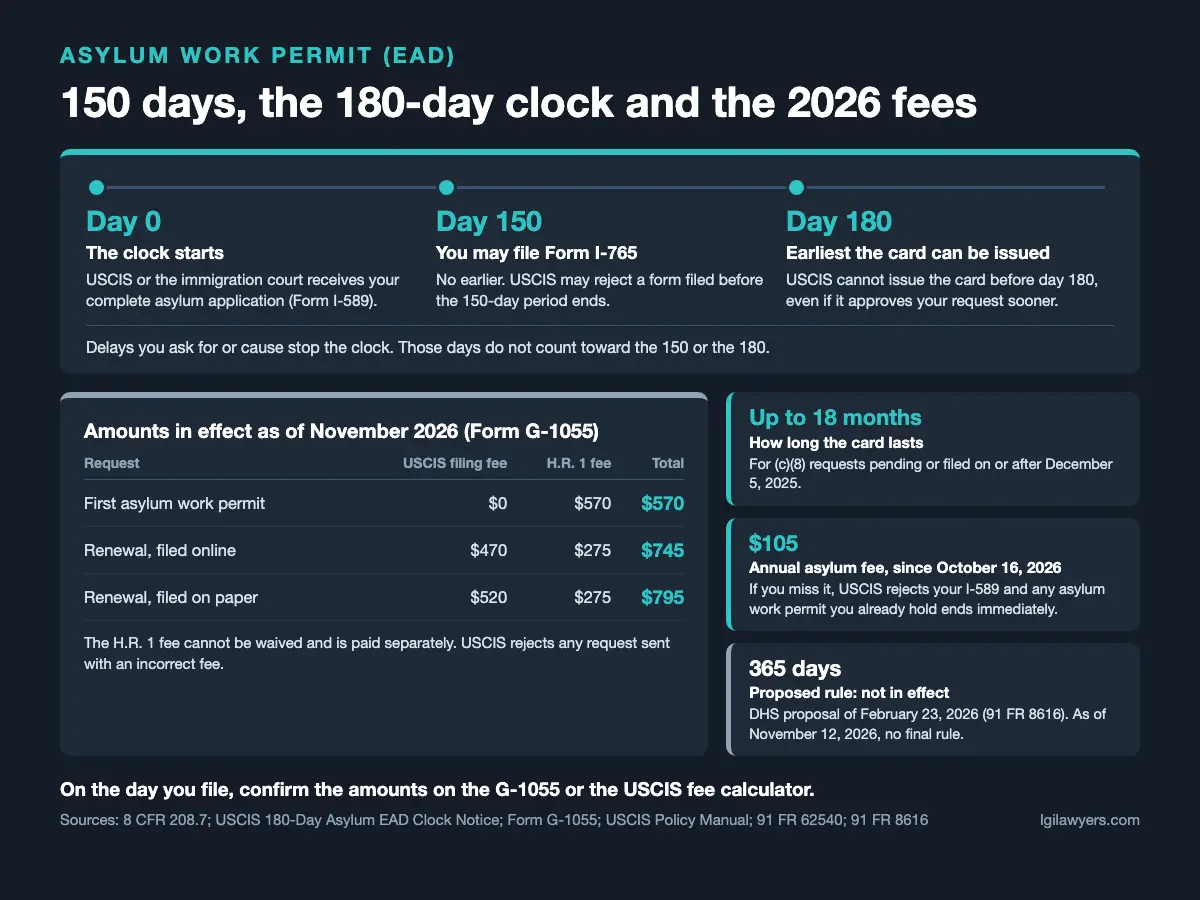
Start counting on the day USCIS or the court received your complete I-589. You may file Form I-765 no earlier than day 150. USCIS cannot issue the card before day 180, even if it approves your request sooner.
USCIS calls this period the 180-day Asylum EAD Clock. Its official clock notice, revised in August 2026, explains when it starts:
- Filed with USCIS: on the date USCIS receives a properly filed asylum application.
- Filed with the court: on the date you file a complete application with the immigration court.
- Rejected as incomplete: the clock never starts, and you would need to file again.
After you file Form I-765, USCIS has 30 days to approve or deny it under 8 CFR 208.7. That 30-day window can be extended if USCIS sends you a request for evidence (RFE), a letter asking for more documents. The time between the RFE and your answer does not count.
There is one exception to the 150-day wait. If an asylum officer recommends your case for approval, you may apply as soon as you receive that notice. In its February 2026 proposal, however, the Department of Homeland Security (DHS) states that the USCIS Asylum Division no longer issues recommended approvals.
Filing too early has a cost. USCIS warns on its I-765 page that it may reject a form filed before the 150-day period ends. Keep your I-589 receipt notice where you can find it, and use its date to count the days.
What stops the asylum clock
Delays that you, or a dependent included in your application, ask for or cause stop the clock. The days during that pause do not count toward either the 150-day or the 180-day requirement.
For cases with USCIS, the clock notice lists common examples:
- missing your biometrics appointment, where USCIS takes fingerprints and a photo, without good cause;
- asking for more time to submit documents, if the interview must be rescheduled;
- transferring your case to another asylum office, including after a change of address, when the interview must be rescheduled;
- submitting a large volume of evidence right before the interview, forcing a new date;
- asking to reschedule the interview for a later date;
- not bringing a competent interpreter to the interview.
Missing the interview itself is more serious. The clock stops that day, and you may lose eligibility unless you send a written request within 10 days showing exceptional circumstances.
Some events do not affect the clock. If USCIS cancels the interview through its own fault, or refers your case to the court, the count continues.
In immigration court, the judge assigns a reason each time a hearing ends without a decision. If the delay is attributed to you, the clock stops until the next hearing. A motion for a continuance (a request to postpone) that the judge grants also stops it.
Check your count regularly. For USCIS cases, the Case Status Online tool shows whether the clock is stopped. For court cases, call the automated line of the Executive Office for Immigration Review (EOIR) at (800) 898-7180. EOIR is the agency that runs the immigration courts. If you believe the count is wrong, USCIS and EOIR each accept correction requests and aim to answer within 25 business days.
Do you know how much time you have left to act?
In immigration matters, deadlines are strict and rarely extended, and missing one can permanently remove options that were available to you. Building a strong case also takes time: gathering evidence, preparing documents, and reviewing your history. That means the real window to act is always shorter than the deadline itself.
How much the asylum work permit costs in 2026
The first permit costs $570 in total. USCIS charges no filing fee of its own for an initial (c)(8) request. The $570 is a separate fee created by H.R. 1, the 2025 budget law that added several immigration fees.
Here are the amounts in effect as of November 2026, according to the USCIS fee schedule (Form G-1055):
| Request | USCIS filing fee | H.R. 1 fee | Total |
|---|---|---|---|
| First asylum work permit | $0 | $570 | $570 |
| Renewal, filed online | $470 | $275 | $745 |
| Renewal, filed on paper | $520 | $275 | $795 |
The $570 initial fee and the annual asylum fee adjust every year for inflation. The current amounts took effect on October 16, 2026, under the fiscal year 2027 adjustment notice. H.R. 1 provides no inflation adjustment for the $275 renewal fee.
The H.R. 1 fee is paid separately from any USCIS filing fee. The G-1055 states that USCIS rejects any request sent with an incorrect fee.
Your asylum case carries its own yearly cost. The annual asylum fee rose to $105 on October 16, 2026, from $102. If you miss it, USCIS rejects your I-589, and any asylum work permit you already hold ends immediately, according to the May 2026 interim rule and 8 CFR 208.7(b)(1). A pending work permit request is rejected or denied as well. Our guide to the consequences of not paying the annual asylum fee explains how to protect your case.
On the day you file, confirm the amounts on the G-1055 or the USCIS fee calculator.
How to apply with Form I-765 and how long the card lasts
You can file Form I-765 online through a USCIS account or on paper. On the form, you enter (c)(8) as your eligibility category. The filing address depends on that category.
Use the right edition of the form. As of November 12, 2026, USCIS accepts only the 08/21/25 edition of Form I-765 and rejects the 09/15/26 edition. The edition date appears at the bottom of each page.
Plan for these steps:
- Pay the $570 H.R. 1 fee as a separate payment, apart from any other fee.
- Attend any biometrics appointment USCIS schedules, since missing it without good cause stops your clock.
- Keep your mailing address current with USCIS, because the card arrives by mail.
A new asylum work permit lasts up to 18 months. The USCIS Policy Manual set that limit for (c)(8) requests pending or filed on or after December 5, 2025.
A renewal has the same 18-month limit. If filed on or after October 30, 2025, it no longer extends your old card automatically, under a rule made final on October 14, 2026. Our guide to renewing a work permit covers timing and forms.
What the proposed rule would change
If DHS finalizes its proposal, most new applicants would wait a full year, and new applications could stop entirely for a long period. None of this is in effect today.
The proposal is titled “Employment Authorization Reform for Asylum Applicants.” DHS published it on February 23, 2026, at 91 FR 8616. Public comments closed on April 24, 2026. As of November 12, 2026, the Federal Register shows no final rule.
The main proposed changes are these:
- A 365-day wait. You could apply only 365 calendar days after USCIS received your complete asylum application.
- A pause on new applications. USCIS would stop accepting initial (c)(8) requests while affirmative asylum cases take more than 180 days on average. DHS itself expects that pause could last “possibly many years,” and it would reach court cases too.
- More time for USCIS. The deadline to decide a first request would grow from 30 to 180 days.
- Biometrics for everyone, including renewals.
- Discretion. Approval would become discretionary, meaning USCIS would decide each request case by case.
The proposal would also add new grounds for refusal:
- reason to believe a criminal bar to asylum applies;
- an asylum denial before the work permit decision;
- an asylum application filed more than one year after arrival, unless an officer or judge finds an exception;
- entry without inspection, unless you expressed fear or an intent to seek asylum to an officer within 48 hours, or show good cause.
The last two would apply only to asylum applications or entries after the final rule takes effect. Unaccompanied children have exceptions.
According to the proposal, initial requests already pending on the effective date would keep today’s rules. Existing cards would stay valid until they expire. A final rule may differ from the proposal. If you are close to day 150, talk to an attorney about your timing.
Frequently asked questions
Can I work while I wait for my work permit?
Not on the basis of your asylum case alone until USCIS approves your Form I-765. USCIS cannot issue the card before your asylum case reaches 180 days on the clock. If you hold another status that allows work, ask an attorney how it fits with your asylum case.
What happens if my case is in immigration court?
You follow the same 150-day and 180-day rules, and you still file Form I-765 with USCIS. Your clock starts when you file a complete I-589 with the court. Delays the judge attributes to you stop it until the next hearing.
Can I ask for a fee waiver?
Not for the H.R. 1 fee: the $570 for a first permit and the $275 for a renewal cannot be waived. The Form I-912 page lists (c)(8) renewals among the requests where you may ask USCIS to waive its separate filing fee, if you qualify. You still pay the $275 separately.
What happens if I do not pay the annual asylum fee?
USCIS rejects your asylum application, and any asylum work permit you already hold ends immediately under 8 CFR 208.7(b)(1). A pending work permit request is rejected or denied too. Pay within the time your fee notice gives. Our guide on what happens if you miss the annual asylum fee explains the details.
Will the proposed rule affect me if I already have a work permit?
Under the proposal as written, your current card would stay valid until its expiration date, unless it is terminated or revoked for other reasons. Renewals filed after a final rule would face the new eligibility requirements. They would not face the 365-day wait or the pause. A final rule may change these terms.
How long does my asylum work permit last?
Up to 18 months for requests pending or filed on or after December 5, 2025. The 18 months is a maximum: the card ends sooner if your asylum application is denied or rejected. Plan your renewal early, because a pending renewal no longer extends your card.
Protecting your right to work while your asylum case is pending
Your right to work rests on two counts that you can check: the days your asylum case has been pending and the delays charged to you. If either looks wrong, USCIS and the court both accept correction requests. Paying the annual asylum fee on time avoids one way of losing the permit you already have.
Asylum applicants in Virginia, Washington D.C., and Maryland, whether their case is with USCIS or in immigration court, can turn to Law Group International. Attorneys Khalid Shekib and Daniela Lucena can review your clock, your fees and your filing date. More on our asylum application services and on the asylum process in the United States.
Before day 150 arrives, check your clock and your fee notices so a small error does not cost you weeks.
Ready to prepare your case with an experienced immigration team?
Schedule a consultationKhalid Shekib & Daniela Lucena · Law Group International
Offices in Alexandria, VAThis article provides general information and is not legal advice. Reading it does not create an attorney-client relationship with Law Group International. Immigration law changes often and every case is different, so speak with an immigration attorney about your own situation.
Sources
- 8 CFR 208.7, Employment authorization (eCFR)
- USCIS, Form I-765, Application for Employment Authorization
- USCIS, The 180-Day Asylum EAD Clock Notice (revised August 2026)
- USCIS, Form G-1055, Fee Schedule (edition 10/26/26)
- USCIS, Form I-912, Request for Fee Waiver
- Federal Register, Fiscal Year 2027 Inflation Adjustment to H.R. 1 Immigration Fees, 91 FR 62540
- Federal Register, USCIS Immigration Fees and Related Procedures Required by H.R.1, 91 FR 22952
- Federal Register, Employment Authorization Reform for Asylum Applicants (proposed rule), 91 FR 8616
- Federal Register, Removal of Automatic Extensions for Certain Employment Authorization Documents, 91 FR 65306
- USCIS Policy Manual, Volume 10, Part A, Chapter 4
- USCIS Policy Alert, Updating Certain Employment Authorization Document Validity Periods (December 4, 2025)
Last updated: November 2026