

212(h) waiver: who qualifies and how to apply
A past conviction can stop a green card case even when everything else is in order. The 212(h) waiver is the tool Congress created for some of those cases, though not for all of them.
Immigration law lists reasons the government can refuse an immigrant visa or permanent residence. It calls them grounds of inadmissibility, and several of them are criminal. A waiver is the government’s decision to set one of those grounds aside.
Three questions decide most cases: what is on your record, which of the three paths fits you, and whether the statute shuts you out. This guide takes them in that order, with the text of the law in hand.
What the 212(h) waiver is
It is a discretionary waiver named for section 212(h) of the Immigration and Nationality Act, or INA 212(h). It lets the government forgive certain criminal grounds of inadmissibility.
The 212(h) waiver and Form I-601 are not two different waivers. Form I-601 is the application you file to request it. The same form is used for several other waivers, each with its own legal basis and its own requirements.
The statute speaks of people applying for a visa, for admission to the United States, or for adjustment of status. Adjustment of status is the process of getting permanent residence without leaving the country.
Which criminal grounds a 212(h) waiver can forgive
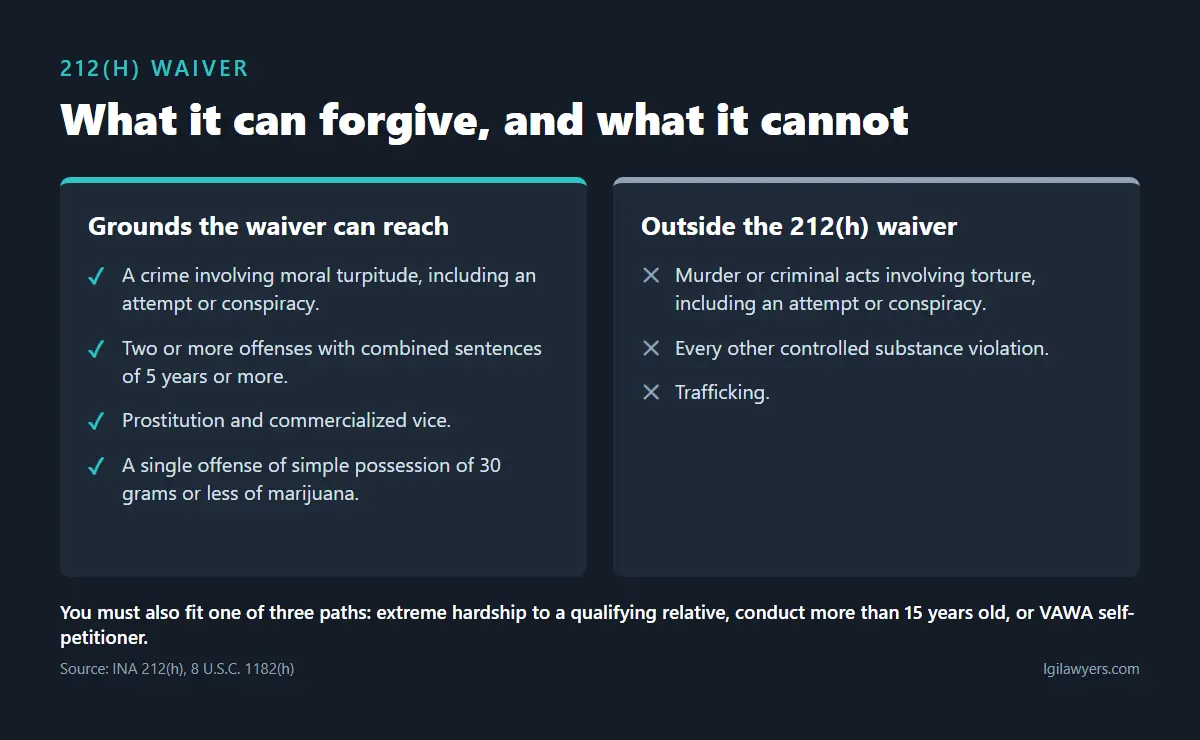
Section 212(h) points to a closed list. Under its text, the waiver can reach:
- A crime involving moral turpitude, including an attempt or conspiracy to commit one.
- Two or more offenses with combined sentences to confinement of 5 years or more, whether or not they involve moral turpitude.
- Prostitution and commercialized vice.
- A single offense of simple possession of 30 grams or less of marijuana.
“Moral turpitude” deserves a pause, because it often decides the case. It is a legal category that the immigration statute names but does not define, and the statute gives no list of offenses. The USCIS Policy Manual in its naturalization chapter on good moral character, summarizes how courts have described it: conduct that shocks the public conscience as being inherently base, vile, or depraved, contrary to the rules of morality and the duties owed between persons or to society in general. That description guides the analysis but does not settle individual cases: each offense has to be analyzed on its own.
One detail sometimes makes the waiver unnecessary. The statute describes two situations in which a crime involving moral turpitude does not make a person inadmissible, as long as the person committed only one crime. The first: the crime was committed before age 18, and both the crime and any release from confinement imposed for it took place more than 5 years before the application for a visa or for admission. The second: the maximum possible penalty for the crime did not exceed one year of imprisonment and, if there was a conviction, the sentence imposed did not exceed 6 months, regardless of how much of it was served.
Before you apply for a waiver, have an attorney check whether you need one. Bring the complete court record to that review, not a summary.
What the waiver does not cover
No 212(h) waiver is available to a person convicted of murder or of criminal acts involving torture. The bar also reaches a person who has admitted committing those acts, and it covers an attempt or conspiracy to commit them.
On drugs, the statute allows a waiver in one situation only: a single offense of simple possession of 30 grams or less of marijuana. Every other controlled substance violation falls outside the 212(h) waiver. Trafficking is likewise missing from the grounds this section allows the government to waive.
Being outside 212(h) does not always mean being out of options, because other waivers exist with different requirements. Our guide to waivers in immigration court walks through them. If your record falls into one of these categories, talk to an attorney before you file anything.
Three ways to qualify under INA 212(h)
A waivable offense is only half the test. The statute also requires you to fit one of three paths, and each calls for different evidence.
Extreme hardship to a family member
Start with the relationship. You must be the spouse, parent, son, or daughter of a U.S. citizen or a lawful permanent resident. You must then show that denying your admission would cause extreme hardship to that relative.
The law looks at your relative, not at you. What you would suffer without a green card is not what this path measures.
The statute does not define extreme hardship. The Form I-601 instructions do list factors considered by U.S. Citizenship and Immigration Services (USCIS), the agency that decides immigration applications. They include health, financial considerations, education, personal considerations, and special factors.
Conduct more than 15 years old
Picture someone with one conviction from their twenties and two decades of steady life since. A path exists for that person, and it does not depend on having a qualifying relative.
It has three requirements, and all three apply together:
- The activities occurred more than 15 years before the date you apply for a visa, admission, or adjustment of status.
- Your admission would not be contrary to the national welfare, safety, or security of the United States.
- You have been rehabilitated.
Meeting two of the three is not enough.
This path has a variation. A person who is inadmissible only under the prostitution ground does not need to wait 15 years. That person still has to meet the other two requirements.
VAWA self-petitioners
What if the relative who could sponsor you is the person who abused you? The Violence Against Women Act, known as VAWA, lets certain victims of battery or extreme cruelty file their own petition. A person who does so is called a self-petitioner.
Section 212(h) gives them a third path. The text says only that the person “is a VAWA self-petitioner.” It adds no hardship requirement and no waiting period on this path.
The two official sources do not use the same words here. The statute refers to a person who “is” a VAWA self-petitioner, and INA 101(a)(51) defines that term as a person who qualifies for relief under certain petitions. The form instructions refer to an “approved” VAWA self-petitioner. The cautious reading is that a pending petition may not be enough, so raise the point with your attorney.
Special limits for lawful permanent residents
Anyone previously admitted as a lawful permanent resident faces two extra limits on top of everything above. Under the statute, no waiver can be granted in either of these situations:
- Since that admission, the person has been convicted of an aggravated felony, a category the immigration statute defines through a list of offenses in INA 101(a)(43).
- The person has not lawfully resided continuously in the United States for at least 7 years immediately before the date removal proceedings were initiated.
Note the cutoff in the second limit. The clock stops when the government started the case, not on the day of the hearing.
Who counts as “admitted as a lawful permanent resident”? The Board of Immigration Appeals and the Court of Appeals for the Fourth Circuit, whose jurisdiction includes Virginia, have read the phrase to mean a person who entered the United States after inspection while already holding permanent residence, at any point in the past. Under those decisions, a person who obtained a green card through adjustment of status inside the country, and never entered as a permanent resident, is not barred by the aggravated felony limit. If you got your green card inside the United States, ask an attorney how these limits apply to your case.
Neither limit is simple to apply. Whether a particular offense is “aggravated,” and how your admission history counts, are technical questions to answer with your immigration and criminal records in hand.
If you hold a green card and have a record, our guide on whether green card holders can be deported gives useful background. A separate defense with its own rules also exists: cancellation of removal for lawful permanent residents. Ask someone to check these two limits before you prepare any application.
Violent or dangerous crimes face a higher standard
Fitting one of the three paths is sometimes still not enough. A federal regulation, 8 CFR 212.7(d), sets a tougher rule for cases involving violent or dangerous crimes.
In those cases the government “in general, will not favorably exercise discretion,” except in extraordinary circumstances. The regulation gives examples: national security or foreign policy considerations, or a clear showing of exceptional and extremely unusual hardship.
The regulation then goes a step further. Depending on the gravity of the offense, even extraordinary circumstances might be insufficient.
The rule does not define “violent or dangerous” or list offenses, so we do not offer a list either. If your record includes an offense against a person, put this question to your attorney at the first meeting, not the last.
How to apply for a 212(h) waiver
You apply on Form I-601, the Application for Waiver of Grounds of Inadmissibility. Do not confuse it with Form I-601A, which according to its instructions is only for unlawful presence. We explain how I-601, I-601A, and I-212 waivers differ in a separate guide.
Where you file depends on where your case stands:
- After a consular interview. If a consular officer finds you inadmissible, you file Form I-601 with USCIS. The agency decides and informs both you and the consular officer.
- With adjustment of status. A person applying for permanent residence inside the United States can file Form I-601 as part of that process. The instructions also cover filing it after you have already submitted your green card application (Form I-485).
- In immigration court. The form instructions contemplate filing in immigration court in connection with an application for relief from removal. In that setting, the immigration court grants or denies the waiver.
A dated notice matters here. On October 7, 2026, USCIS changed the filing location for Form I-601 sent by mail. The agency says it will accept forms postmarked on or before November 9, 2026, that go to a prior location. We do not reproduce addresses because they just changed. Check the official page on the day you mail your form.
We do not list fee amounts either. USCIS publishes the current fee in its official fee schedule.
The most important feature of the process comes last. The 212(h) waiver is discretionary. Meeting the requirements lets you ask for it, but it does not require the government to say yes. In the words of the instructions, in all cases you must show that the favorable factors outweigh the unfavorable ones.
The statute also limits review of these decisions by the federal courts. Section 212(h) itself says no court has jurisdiction to review a decision to grant or deny this waiver. INA 242(a)(2)(D) still allows constitutional claims and questions of law to be raised in a petition for review before a federal court of appeals.
What evidence helps
The Form I-601 instructions mention, among other items:
- Complete court records for any conviction or charge, from any country.
- Evidence of rehabilitation, where it applies.
- Evidence that your admission would not be against the national welfare or security.
- Affidavits and medical reports.
On the family path you must prove two things: the relationship and the hardship. Birth and marriage certificates establish the first. For the second, the instructions point to affidavits from the relative, expert opinions, payroll records or tax statements, monthly expenses, medical documentation, and country-condition reports.
One rule surprises people when it is too late to fix. An approved waiver covers only the grounds and the incidents you included in the application. An arrest left out through oversight or embarrassment is not protected.
So the first practical step is not writing letters. It is ordering certified copies of every criminal record you have, including old or closed cases. Our guide on how criminal charges affect immigration status explains why each document counts. If your case involves more than one ground, see also how the I-601 waiver of inadmissibility works for other grounds.
Every case is different, and with this waiver the details in the file matter more than the general rules.
Frequently asked questions
Can I get a 212(h) waiver for a drug conviction?
Only in one situation: a single offense of simple possession of 30 grams or less of marijuana. The statute leaves out every other controlled substance violation, and trafficking as well. If your conviction is of another kind, an attorney should review whether a different path exists.
What counts as extreme hardship to my relative?
The statute does not define it. The Form I-601 instructions list health, financial, educational, and personal factors, along with special factors such as cultural obstacles or a valid fear of harm. What counts is the situation of your spouse, parent, son, or daughter, not your own. Each factor needs documents behind it.
I already have a green card. Can I still apply?
That depends on two limits the statute sets for people admitted to the country as permanent residents. You cannot receive the waiver if you were convicted of an aggravated felony after that admission. You also cannot receive it without at least 7 years of continuous lawful residence before removal proceedings began. According to the Board of Immigration Appeals and the Fourth Circuit, a person who adjusted status without ever entering as a permanent resident is not barred by the aggravated felony limit. If you got your green card inside the United States, talk to an attorney: applying these limits to your history is technical work.
Can I ask for the waiver if my case is in immigration court?
The form instructions contemplate filing Form I-601 in immigration court in connection with an application for relief from removal. In that setting the immigration court grants or denies the waiver. How and when to raise it depends on your case, so discuss it with your attorney before the hearing.
How long does a 212(h) waiver take?
Neither the statute nor the regulation sets a deadline, so we do not give a number. USCIS publishes processing times by form on its website, and those figures change often. If your case is in immigration court, timing depends on that process.
A record does not decide the case, but it does decide where to start
Order matters. First, know exactly what your criminal record says. Next, check whether the statute shuts you out. Only then choose a path and gather the evidence.
At Law Group International, attorneys Khalid Shekib and Daniela Lucena handle criminal inadmissibility cases for families in Virginia, Washington D.C., and Maryland. If you would like your record reviewed, bring every court document you have to the first appointment, including the ones you think no longer matter.
Ready to prepare your case with an experienced immigration team?
Schedule a consultationKhalid Shekib & Daniela Lucena · Law Group International
Offices in Alexandria, VAThis article provides general information and is not legal advice. Reading it does not create an attorney-client relationship with Law Group International. Immigration law changes often and every case is different, so speak with an immigration attorney about your own situation.
Sources
- Immigration and Nationality Act section 212, 8 U.S.C. 1182: criminal grounds of inadmissibility and the subsection (h) waiver
- 8 CFR 212.7: waiver of certain grounds of inadmissibility
- USCIS: Form I-601, Application for Waiver of Grounds of Inadmissibility
- USCIS: Instructions for Form I-601
- USCIS: Fee Schedule, Form G-1055
- Immigration and Nationality Act section 242, 8 U.S.C. 1252: judicial review
- Immigration and Nationality Act section 101, 8 U.S.C. 1101: definitions of aggravated felony (a)(43) and VAWA self-petitioner (a)(51)
- USCIS Policy Manual, Volume 12, Part F, Chapter 5: crimes involving moral turpitude
- Board of Immigration Appeals (EOIR): Matter of J-H-J-, 26 I&N Dec. 563 (BIA 2015)
- Board of Immigration Appeals (EOIR): Matter of Vella, 27 I&N Dec. 138 (BIA 2017)
- U.S. Court of Appeals for the Fourth Circuit: Leiba v. Holder, No. 11-1845 (2012)
Last updated: November 2026